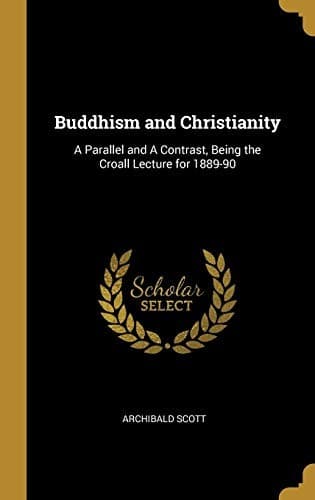
Buddhism and Christianity: A Parallel and a ContrastScott, Archibald
Religion
Buddhism and Christianity: A Parallel and a Contrast
Scott, Archibald
Buddhism -- Relations -- Christianity; Christianity and other religions -- Buddhism
If this be not impure Christianity, no one will dare to call it pure
Buddhism. Surely it is a hopeful indication for the future of Japan, as
being evidently a movement somewhat similar to that inaugurated in India
by Rammohun Roy, and greatly furthered in our days by Chunder Sen. The
first professed to trace his reform to the Upanishads rediscovered, and
expounded, and applied; and the second to the Vedas as the primitive
fountains of the faith. Both reformers and their work would have been
impossible two thousand years ago; yea, they would have been equally
impossible to-day, had not the West given of its thoughts to the East,
and Christendom communicated to it something of its better life. It is
one thing to read the Vedas and Upanishads, as the Rishis recited or the
Brahmans expounded them long ago, and quite another to have them
interpreted by natives of India, around whose forefathers for several
generations all the influences of Christian civilisation have been
playing. So is it with the reforming Buddhists of China and Japan, who
have enterprise to send their sons to study at our British Universities.
They are reading their old literature—even when rejecting our systems of
belief—with minds unconsciously saturated with Christian intelligence,
and no doubt they often find there what the Gospel has put in
themselves.
We may rest assured that the reform of the Oriental religions will only
be effected by the infusion into them of the spirit of Christianity. A
higher religion meeting them as Christianity does, may not supplant or
destroy them, but it will revive and transform them. It will destroy
much that is false, correct much that is wrong, supply all they lack,
and so in the end annul them. The product will not likely be a facsimile
of any of the Churches of Christendom. It may be a religion in which
Buddha and the great teachers of his system will be lifted to their
places among the prophets who, “since the world began,” unconsciously
testified, by their errors as well as by their truths, by their failures
as well as by their successes, to the Mystery to be revealed. The fact
that in Buddhism the object of worship is not the Buddha that was, but
Mâitrêya who is to be, is a pathetic confession that its Messiah has yet
to come. Though Buddha did not proclaim His coming, the result of his
mission bears witness to the need of Him. So he was a lawgiver preparing
the way for Moses, even as Moses prepared the way for the Baptist, and
as the Baptist heralded the Christ of God. Could his voice reach down
to-day from “the quiet shore” to the millions who have taken hold of him
in hope of finding deliverance from the miseries and perplexities of
this sinful world, it would be to repeat a testimony once heard on
Jordan’s banks from him than whom no one born of woman was greater:
“There standeth One among you whom ye know not, the latchet of whose
shoes I am not worthy to unloose.”
Footnote 319:
Mahâparanibhâna Sutta, ii. 33. 35.
Public-domain text, read in full here on John Shaqi.
Reviews
Reviews
No reviews yet
Be the first to share your thoughts on this work.
Elsewhere in the archive
Join the Discussion
Join the discussion
Sign in to leave a comment or review.
Sign InorCreate an account