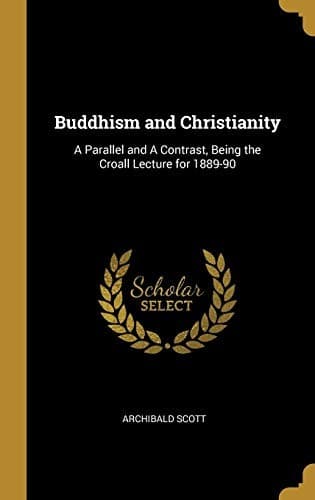
Buddhism and Christianity: A Parallel and a ContrastScott, Archibald
Religion
Buddhism and Christianity: A Parallel and a Contrast
Scott, Archibald
Buddhism -- Relations -- Christianity; Christianity and other religions -- Buddhism
A writer in the _Nineteenth Century_, October 1889, professes to
describe the testimony of the only reporter who has written of Lhása
since Huc and Gabet were expelled from it forty-five years ago.
According to this witness, the Church is now actually in grip of the
State, though nominally dominant. Of five members of the Council of
the Grand Lama four are laymen, superior military officers, with the
Regent at their head. Till the Grand Lama is eighteen years of age,
the Regent is supreme, and for sixty years, not a single Grand Lama,
chosen as an infant, has survived his eighteenth birthday!!
Footnote 368:
Buddhism, however, introduced into Tibet the benefits of the art of
writing, the reduction of its language to an alphabet, and grammar;
and not only the sacred literature represented by the collection of
the Kandjur, but the very miscellaneous literature of the Tandjur.
Several of its Buddhist missionaries and the kings who favoured them
were really great men. Kublai Khan and the first Lamistic Pope
Phags-pa, 1259-94, rendered lasting service to the cause of
civilisation. See Köppen’s _Die Lamaische Hierarchie und Kirche_,
being vol. ii. of his celebrated and most laborious work, _Die
Religion des Buddha_; T. W. Rhys Davids, Art. LAMAISM, _Encyc. Brit._
vol. xiv.; Sir Monier Williams, _Buddhism_, pp. 262-302.
Footnote 369:
The most recent and reliable information as to this perverted form of
Buddhism—if it is to be called Buddhism, for it seems to be no more
Buddhism than Vandoux worship can be called Christianity—will be found
in the works of T. W. Rhys Davids; Sir Monier Williams, _Buddhism_;
Babu Sarat Chunder Das, “Religious Hist. of Thibet,” _Journ. Asiat.
Soc. Beng._ 1881; _Life and Works of Alex. Csoma de Koros_, Th. Duka,
Lond. 1885; E. Colborne Baber, _Travels and Researches in Western
China_; Bushell’s “Hist. of Thibet,” _Journ. R.A.S._ vol. xii.
1878-79.
Footnote 370:
An invocation of Avalôkitês’vara, who is believed to have delivered it
to the Tibetans.—Klaproth, _Fragments Bouddhiques_, p. 27; Hodgson,
_Illustrations_, p. 171; Charles Loring Brace, _Gesta Christi_, p.
455.
Footnote 371:
Schlagintweit, _Buddhism in Tibet_, pp. 227-272.
Footnote 372:
_Chinese Review_, vol. xi. p. 162; Beal, _Buddhism in China_, p. 233.
Footnote 373:
Once when a heathen asked Hillel to show him the whole Jewish religion
in a few words, he replied, “_Do not unto others what thou wouldst not
should be done unto thee_.” Kuenen’s _Religion of Israel_, p. 243
(quotes Talmud, Sabbath, 31 a.)
Footnote 374:
See Isaiah xxxii. 5, 6. Socrates says in _Phaedo_, “to use words
wrongly and indefinitely is not merely an error in itself; it also
creates evil in the soul.” A vast amount of mischief is done by the
misapplication of good adjectives to bad subjects. All true reformers,
with Confucius, labour for a rectification of names.
Footnote 375:
Public-domain text, read in full here on John Shaqi.
Reviews
Reviews
No reviews yet
Be the first to share your thoughts on this work.
Elsewhere in the archive
Join the Discussion
Join the discussion
Sign in to leave a comment or review.
Sign InorCreate an account