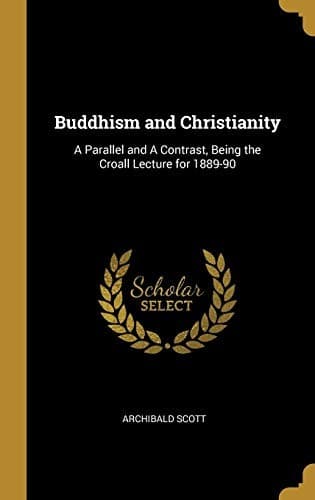
Buddhism and Christianity: A Parallel and a ContrastScott, Archibald
Religion
Buddhism and Christianity: A Parallel and a Contrast
Scott, Archibald
Buddhism -- Relations -- Christianity; Christianity and other religions -- Buddhism
Nâgârdjuna, the Nagasēna of the Milindipanha, was the chief
representative, if not founder, of one of the Mahāyāna Schools. He has
been regarded as a mythical personage, and the name has been supposed
to be the generic one of various authors and doctors of the system.
For an account of Hināyāna and Mahāyāna doctrine, with its
subdivisions, see Wassilief, _Le Bouddhisme, etc._, pp. 9 _seq._, 118
_seq._; Schlagintweit, _Buddhism in Tibet_, pp. 19-57. Nâlanda must
have been a very important centre in Buddhist times.—Fergusson, _Tree
and Serpent Worship_, p. 79.
Footnote 358:
Dr. Edkins says about 190 A.D.
Footnote 359:
Burnouf, _Introd. à l’histoire du Bud. Ind._ vol. i. pp. 220, 224
(Paris, 1844); also Burnouf, _Le Lotus de la bonne Loi_, chap. xxiv.
pp. 261-268; also Appendix III. pp. 498-511 (Paris, 1852).
Footnote 360:
Müller, Gifford Lectures, _Natural Religion_, p. 543; Dr. Beal,
_Buddhism in China_, p. 123; Sir Monier Williams, _Buddhism_, p. 195.
Footnote 361:
Hodgson, _Illustrations of the Literature and Religion of the
Buddhists_, p. 30; Burnouf, _Introduction, etc._, pp. 116-121; also in
note at p. 118, quoting Hodgson.
Footnote 362:
Though strong affinities exist between Gnosticism and Buddhism, which
may indicate later connection, in their origin they appear to have
been quite distinct. The methods, aims, and terminology of Gnosticism,
all betoken derivation from purely Western sources. It is quite
possible that Gnosticism may have given Adi-Buddha to the East, but
the question of their relations is still undetermined. See Weber,
_Hist. Ind. Lit._ p. 309; Obry’s _Nirvana, etc._, p. 161; Bishop
Lightfoot, Essay on the Essenes (_Epistle to Colossians_), p. 157;
_Home and Foreign Review_, vol. iii. pp. 143 _seq._ (1863).
Footnote 363:
Sir Monier Williams, _Buddhism_, p. 203; Dr. Beal, _Chinese Buddhism_,
p. 128; Dr. Eitel, _Lectures_, p. 98.
Footnote 364:
Kullavagga, v. 21. 4; _Sacred Books of the East_, vol. xx.
Footnote 365:
_Introd._ § vi. p. 558: “La plume se refuse à transcrire des doctrines
aussi misérables quant à la forme, qu’odieuses et dégradantes pour le
fond.”
Footnote 366:
Âryasanga, founder of the Yôgacharya or contemplative system of
Mahāyāna (_circa_ 400 A.D.). For an account of his doctrine, see
Wassilief, _Le Boudd._ pp. 288 _seq._, and Schlagintweit, _Bud. in
Tibet_, pp. 39 _seq._, 46 _seq._; Rhys Davids, _Buddhism_, p. 207
_seq._
Footnote 367:
Public-domain text, read in full here on John Shaqi.
Reviews
Reviews
No reviews yet
Be the first to share your thoughts on this work.
Elsewhere in the archive
Join the Discussion
Join the discussion
Sign in to leave a comment or review.
Sign InorCreate an account