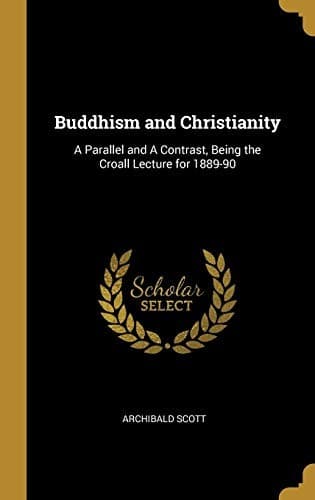
Buddhism and Christianity: A Parallel and a ContrastScott, Archibald
Religion
Buddhism and Christianity: A Parallel and a Contrast
Scott, Archibald
Buddhism -- Relations -- Christianity; Christianity and other religions -- Buddhism
In protesting against the Mass, the Reformed Churches maintain the
universal priesthood, and therefore perpetual sacrifice, of the
visible Church. As Christ’s witness on earth, the Church must be
always offering itself, in thanksgiving for its own redemption, for
the salvation of the world.
Footnote 386:
Fergusson, _Tree and Serpent Worship_, p. 67; Cunningham, _Bhilsa
Topes_, p. 130.
Footnote 387:
Dr. Edkins, _Chinese Buddhism_, p. 126; Judges vi. 31.
Footnote 388:
Originally called Bódhitara, but renamed by his teacher Payantara, in
token of his religious “insight.” He is said to have brought to China
the famous alms-bowl, which all the Buddhas of the Kalpa have used,
and will use, and whose final disappearance will indicate that the
religion is about to perish. Thus Buddhism has also its San Greal.
Bôdiharma is called the “wall-gazing Brahman,” though a Kshatrya,
because on his arrival in China he spent nine years in silent
meditation.—Eitel, _Sanskrit Chinese Dict._ p. 24.
Footnote 389:
Dr. Edkins, _Chinese Buddhism_, p. 130.
Footnote 390:
Men who have in vain sought God without have happily found Him in the
witness of their own conscience and affection, but generally they who
conceitedly reject the revelation without them only obscure the seeing
faculty within. “When mysticism threw off external authority it went
mad, as in the revolutionary pantheism of the Middle Ages. When it
incorporated itself more and more in revealed truth, it became a
benign power—as on the eve of the Reformation.”—Vaughan, _Hours with
the Mystics_, vol. ii. p. 356.
Footnote 391:
“Mysticism,” A. Seth, _Encyc. Brit._ vol. xvii. pp. 129-136.
Footnote 392:
Correctly so, if we are to judge of Mysticism even from its purest
phases and its best representatives, _e.g._ the Quietism of Madame
Guyon, the Spiritualism of Swedenborg, the Romanticism of F. von
Hardenberg, better known as Novalis. Even on its speculative or
philosophical side, it would not be difficult to cull from the
writings of the Cambridge Platonists, and the Idealists of Europe and
America, extracts equivalent to the aphorisms of Novalis, that “action
is morbid,” “to dream is to overcome,” that “the soul must abandon the
actual world if it would discover in the recesses of the mystic night
the Queen of Heaven, Eternal Beauty.”—_Hymns to Night_, Schriften,
vol. ii. p. 158.
Footnote 393:
Pâtimokkha; Pârâgikâ Dhammâ, 3; _Sacred Books of the East_, vol. xiii.
Footnote 394:
Beal, Introduction to _Fa-Hian_, p. 42. In an important aspect the
perversion of Christianity was worse than that of Buddhism. The
Buddhist ascetics, though merciless to themselves, never tortured
their vanquished opponents. There is no parallel to the Romish
Inquisition and some Protestant atrocities in any of the annals of
Buddhism.
Footnote 395:
ἡ σωματικὴ γυμνασία, 1 Tim. iv. 8.
Footnote 396:
Public-domain text, read in full here on John Shaqi.
Reviews
Reviews
No reviews yet
Be the first to share your thoughts on this work.
Elsewhere in the archive
Join the Discussion
Join the discussion
Sign in to leave a comment or review.
Sign InorCreate an account