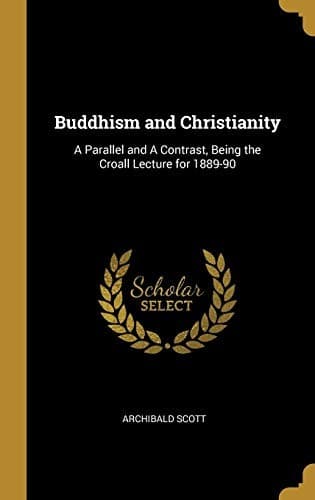
Buddhism and Christianity: A Parallel and a ContrastScott, Archibald
Religion
Buddhism and Christianity: A Parallel and a Contrast
Scott, Archibald
Buddhism -- Relations -- Christianity; Christianity and other religions -- Buddhism
Tylor, _Primitive Culture_, vol. i. p. 440.
Footnote 397:
“Vient enfin le mysticisme de la dernière époque, qui, de même que
tous les mysticismes, finit de la manière la plus misérable, et
enfante une idolâtrie grossière, ainsi que les stupides pratiques de
la sorcellerie” (Laboulaye, Introd. to La Comme’s transl. of
Wassilief’s _Buddhism_, p. xlv). This has often been verified in the
religious history of the West, and the fate of many former “spiritual”
aspirants to enter or to peer into the Invisible and Unutterable
should be a powerful warning to all who are now aiming at surpassing
the natural conditions of existence. In endeavouring to transcend
humanity, we are likely to fall miserably below it.
Footnote 398:
_Chinese Buddhism_, pp. 370-379.
Footnote 399:
Also Seneca: “We do not love virtue because it gives us pleasure, but
it gives us pleasure because we love it.”—_De Vit. Beat._ c. ix. “In
doing good man should be like the vine, producing grapes, and asking
for nothing in having done so.”—M. Aurel. v. 6 and ix. 42.
Footnote 400:
Herzog, _Encyclop._ (Schaff), vol. i. p. 334.
POSTSCRIPT.
In endeavouring to perform the very honourable task assigned to me, I
have had to contend all along with the difficulty of comprising in six
what would require many more lectures properly to relate. Much which was
actually prepared I have been forced to omit, consoling myself with the
thought that, after all, I had simply to lecture and not to write a
compendious treatise, and that it was my business to sketch as
truthfully as I could what it was simply impossible, within the limits
prescribed, adequately to depict. It was originally my intention to give
in parallel quotations the alleged similarities between the contents of
the Pitakas and the New Testament, but the conditions of time and space
compelled me to be content with references to specimens of them in the
_Sacred Books of the East_, from which any ordinary English reader may
be able to form a judgment concerning them. Moreover, when well on with
the work, I discovered that a much more thorough examination of
Professor Seydel’s _Buddhist-Christian Harmony_ than I could profess to
make had already been published by Professor Kellogg of Allegheny, U.S.,
in his book on the _Light of Asia and the Light of the World_. An Indian
missionary of eleven years’ experience, and the author of an excellent
Grammar of the Hindi language, can write upon this subject, not only
with greater authority, but to much better purpose, than one who only
knows Indian books through the medium of European translations, and who
has not seldom been compelled to take on trust what he felt strongly
inclined to question. If Dr. Kellogg’s book is not extensively read in
this country, it certainly deserves to be.
Public-domain text, read in full here on John Shaqi.
Reviews
Reviews
No reviews yet
Be the first to share your thoughts on this work.
Elsewhere in the archive
Join the Discussion
Join the discussion
Sign in to leave a comment or review.
Sign InorCreate an account