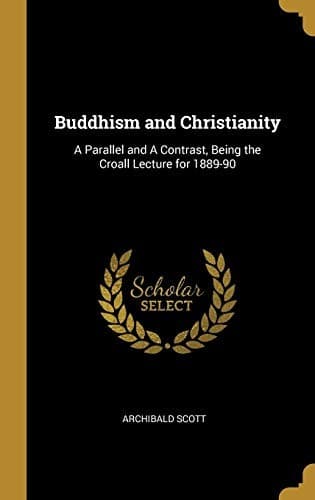
Buddhism and Christianity: A Parallel and a ContrastScott, Archibald
Religion
Buddhism and Christianity: A Parallel and a Contrast
Scott, Archibald
Buddhism -- Relations -- Christianity; Christianity and other religions -- Buddhism
The wealthy are more likely to lend to than to borrow from the poor; the
wise more likely to teach, though they do sometimes learn from the less
instructed. The strong may be infected by the diseases of the feeble,
but generally the contagion of health radiates from the more robust to
the weaker vitalities. The “power” which the touch of the East has “made
to go forth from us”[42] no doubt flows back in quickened life upon
ourselves. As these Oriental studies proceed, the tables will perhaps be
turned upon the school that would derive all our philosophy and religion
from old Indian sources. We have seen that two successive waves of
Western life flowed eastwards upon the shores of India. Another rich
stream of Semitic thought in pre-Buddhistic times, represented by such
religious teachers as the second Isaiah and Jeremiah and Ezekiel,
reached the Tigris, and we may ask, Was the Indus unknown to them? We do
not assert that they knew it, but surely it was just as easy for a Jew
to reach India as for Burnouf or de Bunsen’s Buddhists to reach Babylon.
It was just as probable that a Jewish pedlar found his way eastward
through Parthia to India, with other and more precious goods in his
possession than the Babylonian wares in his pack, as it was that Renan’s
wandering Buddhist monk found his way to the Jordan. Later on there is a
tradition—and though it is only a tradition, what a find to Messieurs
Renan, Burnouf, and de Bunsen would one similar Buddhist tradition
be!—that one of the original twelve apostles of Jesus evangelised a
portion of the western shores of India. So, founding on all these data,
only assuming—as we are entitled to assume—that the East was well
connected with the West by the sea routes from Arabia and by the land
route through Persia, and remembering that there is nothing so volatile
and permeating as thought, is the speculation so very extravagant that
old Indian philosophy and religion, though following their own course,
may have been modified and purified by contact with the thoughts of the
West? What if the conjecture be hazarded that from the West a thousand
years B.C. was communicated the theistic impulse which produced what is
best in the Upanishads—the truth, viz., of the unity which is behind and
above all variety, the One Absolute into which all thought and all being
is resolved?[43] What if it be some day asserted that the teaching of
the Hebrew prophets before the Diaspora, as to the worthlessness of
sacrifice to put away sin and to promote communion with God, may have
insinuated itself into the reveries of Indian ascetics in their forest
retreats, and made the teaching of reformers like Buddha possible? And
what if to St. Thomas may be indirectly traced that influence which made
later Buddhism differ so materially from the primitive, and approach in
the similarities of its legends so close to the Gospel narratives? Dr.
Kellogg already proclaims that “it may be affirmed with certainty that
Public-domain text, read in full here on John Shaqi.
Reviews
Reviews
No reviews yet
Be the first to share your thoughts on this work.
Join the Discussion
Join the discussion
Sign in to leave a comment or review.
Sign InorCreate an account