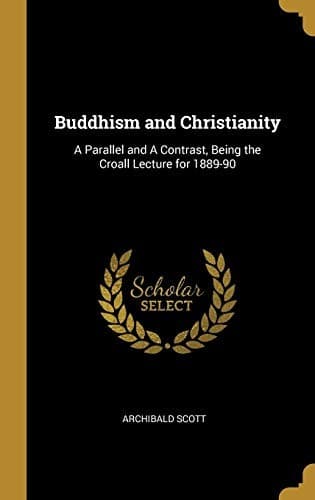
Buddhism and Christianity: A Parallel and a Contrast — John Shaqi
Buddhism and Christianity: A Parallel and a ContrastScott, Archibald
Religion
Buddhism and Christianity: A Parallel and a Contrast
Scott, Archibald
Buddhism -- Relations -- Christianity; Christianity and other religions -- Buddhism
It is not our interest, therefore, to sever Christianity from all
connection with the manifold forms in which the religious instinct and
faculty of man has found expression. If it could be proved that our
religion stands in no relation to anything which men in other religions
thought or believed, it would be discovered defective, and we would have
to abandon the claim that it is the universal religion of humanity. To
assert that all previous religious ideas must be expunged as erroneous
or false, so that an entirely new message might be written, is to
contradict the evangelical doctrine as to the nature of Christ and the
purpose of His mission to the world. The New Testament writers assert
that Christ is the source of all the truth that was ever uttered, the
inspirer of all the goodness that was ever seen, and that He is the
stimulator and educator of man’s every reaching out after God. The
noblest thinkers, it is true, failed to comprehend the truth, and their
highest religion failed to satisfy them; but we must not think of them
as divinely permitted to fail to teach us the glory of Christ as the
ultimate revelation of God. Here, as in all similar cases, failure was
rather a partial success; for by the effort to reach it the mind was
trained to receive and grasp the reality when it was disclosed. Some one
has said that all pre-Christian religions are just Christ partially—very
very partially—realised. Certainly they all point to Him, and but for
Him they would have been abortive. They all suggest Him, in respect that
they each claim something to satisfy and unite them. Christianity thus
proves itself Divine, not in being absolutely different from, nor even
in being vastly superior to, but in the fact that it harmonises and
completes them. Instead, therefore, of being scared by the resemblances
to Christianity which we meet in other religions, we should be thankful
for their discovery. The early Apologists were not frightened when
Celsus,[59] in the second century, submitted his alleged parallels to
Christian doctrine and ethics, in order to prove that what Christians
called revelation had already been attained by the unassisted efforts of
heathen minds. Anticipating the language of the eighteenth century
Deists, he proclaimed that “Christianity was as old as creation.” His
parallels were often found to be defective, and many of them had only to
be looked at to show the immense superiority of the Christian
quotations. Augustine turned them against himself, when he showed that
to claim entire originality for Christianity, to deny the existence of
any light before Christ came, and the possibility of any silent
universal revelation through reason and conscience, was to contradict
His Messiahship. To ignore what God had done before, would have cut Him
off from God and man. We would expect the Son of Man to confirm the
deepest convictions of the human race. We would expect the Son of God to
Public-domain text, read in full here on John Shaqi.
Reviews
Reviews
No reviews yet
Be the first to share your thoughts on this work.
Join the Discussion
Join the discussion
Sign in to leave a comment or review.
Sign InorCreate an account