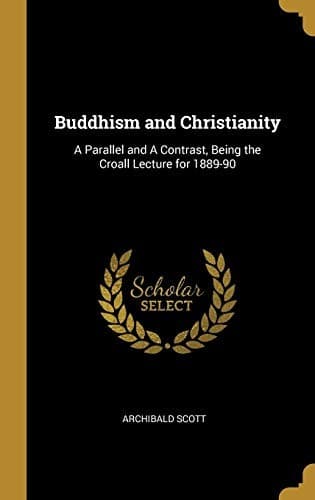
Buddhism and Christianity: A Parallel and a Contrast — John Shaqi
Buddhism and Christianity: A Parallel and a ContrastScott, Archibald
Religion
Buddhism and Christianity: A Parallel and a Contrast
Scott, Archibald
Buddhism -- Relations -- Christianity; Christianity and other religions -- Buddhism
Gotama’s discovery at Bohimanda—The Four Sacred Verities—The noble
Eightfold Way—His theory of life different from but not wholly
antagonistic to that of speculative Brahmanism—Existence not illusion,
but essentially evil—Transmigration—“Modern Buddhists’” defence of the
dogma—Contrast between it and Christian doctrine of the
Fall—Christianity in its sorest struggle with evil hopeful—Buddhism
hopeless—atheistic—materialistic, yet has its own way, not of victory,
but of retreat and escape—Doctrine of Karma analogous to Christian
doctrine of Heredity, yet really contrasted—Goal of all Buddhist
aspiration and effort—Nirvana, point-blank contradiction to Christian
goal, yet way to it analogous—Arhatship as essential in Buddhism as
holiness is in Christianity—Noble quality of Buddhist ethical code—Its
approach to the Christian rule—A law not for all—Its degrees or paths of
perfection—Uprightness—Meditation—Enlightenment—Christ’s way of
salvation and sanctification by the Holy Spirit through the
truth—Essential defects of Buddhist scheme, _Pages 192-252_
LECTURE V.
THE BUDDHIST SANGHA: THE CHRISTIAN CHURCH.
The Church the fruit of Christianity, the Sangha the root out of which
Buddhism sprang—The Sangha not a Church but an Order—Different from the
many Orders then existing, yet with a likeness to them which it never
lost—Renunciation of secular life an indispensable qualification for
membership—Analogous to yet essentially different from Monachism in
Christianity, and in utter contrast to the idea and reality of the
Christian Church—The Sangha as theoretically open to all, and
propagandist in its purpose, a precursor of the Church—Actual
disqualifications for membership—Ceremonial of admission—The “outgoing”
from the world—Ceremonial of Confirmation—The “arrival”—The novitiate or
tutelage—The rule of the Sangha—No vows of obedience to
superiors—Stringent vows of poverty and chastity—Difference between a
Buddhist Vihara and a Christian monastery—Favourable features of
Buddhist monastic life—The Uposatha gathering—The Pâtimokkha
catechising—The Pavârâna invitation—Relation of women to the
Sangha—Institution of Order of Bikkhuni—The relation of the laity to the
Sangha—The Buddhist layman’s only possible “merit,” and his only hope,
_Pages 253-313_
LECTURE VI.
THE RELIGIONS IN HISTORY.
Public-domain text, read in full here on John Shaqi.
Reviews
Reviews
No reviews yet
Be the first to share your thoughts on this work.
Join the Discussion
Join the discussion
Sign in to leave a comment or review.
Sign InorCreate an account