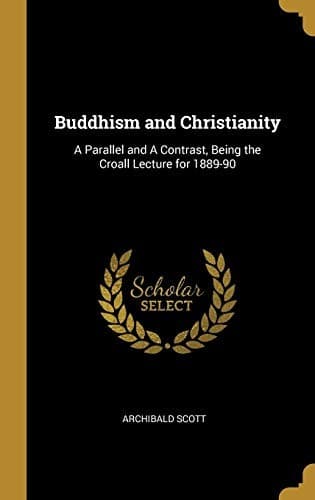
Buddhism and Christianity: A Parallel and a ContrastScott, Archibald
Religion
Buddhism and Christianity: A Parallel and a Contrast
Scott, Archibald
Buddhism -- Relations -- Christianity; Christianity and other religions -- Buddhism
The effect of such a belief was to raise all men who learned of Moses
above the worship and tyranny of Nature, before which so many of the
tribes of mankind have prostrated themselves. It made them regard the
animal creation especially as existing not for their adoration but for
their use; and Nature itself and all its forces as powers to be studied,
subdued, and governed. The germs of man’s faith in his own
imperishableness, implanted from the first, began to sprout the moment
he found himself capable of knowing and serving this Eternal and
Invisible One as the Author and Controller of his being.
Comparisons are often instituted between the Mosaic ethical code and
that of other religions, with the view of showing that there is nothing
peculiar in it, and that instead of being fuller it appears to be even
defective when placed side by side with some of them. The peculiarity of
the Mosaic code is in its first table, which nearly all the others lack.
The Mosaic is an interpretation of the law written in men’s hearts by
the light of religion: it is the manifestation of religious truth as the
real foundation of ethics. Morality has so long been associated with
religion in our thought that we speak at times as if it had been always
so; but among no ancient people, save among the Hebrews, did any
worshipper expect morality from their deities. On the contrary, they
conceived of them as having all their own appetites and passions and
vices, so that as civilisation advanced men were often far nobler and
purer than the gods which they worshipped. When we remember that
physiolatry, from its lowest to its highest form, tolerates and even
consecrates the vilest impurities by its worship, we can realise what a
new and creative power was communicated when the conviction had laid
hold of man that Deity is one who is Himself all that man ought to be,
one who can only be propitiated by righteousness and appeased by truth.
Human progress became not only possible then, but it was secured. So
pure an idea of God meant a loftier idea of man. It involved the poorest
and the humblest of men in vast responsibilities, and therefore it
implied for them rights and dignities equal to those of the highest of
men; for the supreme all-holy Lord God was no respecter of persons, and
the beggar on the dunghill was in His eyes as precious as the prince
upon the throne.[109]
Public-domain text, read in full here on John Shaqi.
Reviews
Reviews
No reviews yet
Be the first to share your thoughts on this work.
Elsewhere in the archive
Join the Discussion
Join the discussion
Sign in to leave a comment or review.
Sign InorCreate an account