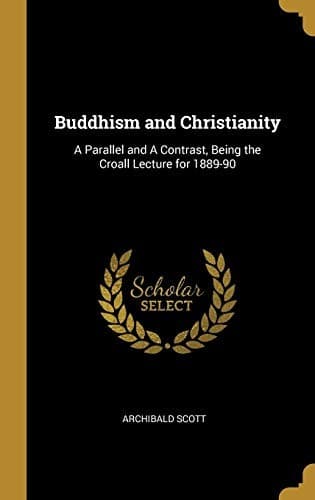
Buddhism and Christianity: A Parallel and a ContrastScott, Archibald
Religion
Buddhism and Christianity: A Parallel and a Contrast
Scott, Archibald
Buddhism -- Relations -- Christianity; Christianity and other religions -- Buddhism
From the period when Vedic speculation first began its course to that in
which it produced its earliest Upanishad, these moral and spiritual
truths were not kept secret among the philosophic few, but were
prophesied in the gates and streets of every Hebrew city. No one can say
that they were thankfully received and loyally obeyed by the people of
Israel; on the contrary, their whole history represents the struggle of
a stubborn and rebellious race against a revelation too pure and
spiritual to be acceptable to them. Their religion was always higher
than themselves, but while towering above them, it perpetually hovered
round them, contradicting their most cherished inclinations, and
condemning their most deeply rooted habits. The invisible God, of whom
no likeness was to be tolerated, who was not to be worshipped even in
the greatest of His works, was too far removed from their sympathies. It
took centuries of severe handling to uproot their strong tendency to
Nature-worship; yea, the Divine detestation of it had to be branded in
the national conscience by their final overthrow. Eventually, however,
the truth got rooted in the mind of a “remnant” of them that God is not
to be worshipped under any symbol, and cannot be enshrined in temples
made with hands; that the heaven of heavens cannot contain Him; that in
gifts and offerings He takes no pleasure, but that He dwells with the
meek and lowly, and finds a pleasing sacrifice in the contrite spirit
and broken heart. The divinity of the revelation seems attested by the
fact that it continued all throughout their history above them, rebuking
and condemning, but never suffering them altogether to fall away from
it. And this is still its relation to ourselves: it is a creed
contradicting our life, a Divine law in direct opposition to all that
claims to be popular; for where even yet is the Christian who can be
said fully to realise all that is summed up in the truth, “God is not to
be worshipped by man as though He needed anything;” “God is a spirit,
and they that worship Him must worship Him in spirit and in truth”?
Public-domain text, read in full here on John Shaqi.
Reviews
Reviews
No reviews yet
Be the first to share your thoughts on this work.
Elsewhere in the archive
Join the Discussion
Join the discussion
Sign in to leave a comment or review.
Sign InorCreate an account