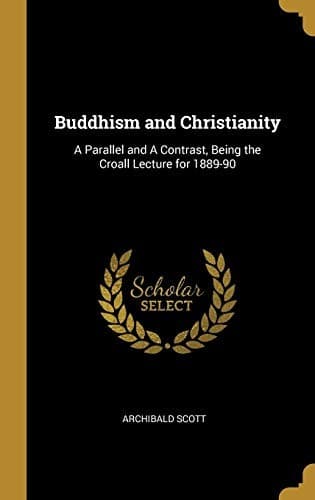
Buddhism and Christianity: A Parallel and a ContrastScott, Archibald
Religion
Buddhism and Christianity: A Parallel and a Contrast
Scott, Archibald
Buddhism -- Relations -- Christianity; Christianity and other religions -- Buddhism
The universality as well as the purity and spirituality of this
fundamental article of the Hebrew faith separates it from and elevates
it above the Indian beliefs. Nature-worship has always been local and
ethnic in its range; the gods of the hills are not the gods of the
valleys, and the deities of Assyria command no reverence in Egypt. To
the Hebrew was first communicated the catholic faith that the one Lord
over all is rich in mercy unto all. The treasure was received, it is
true, in an earthen vessel, by a people who could only apprehend as
children what we are expected to hold in the comprehensions of men.[110]
In patriarchal times by the people generally the One Lord was conceived
of too much as just the protector of the family. In Mosaic times the
great and terrible God who avenged Himself on Egypt was thought of too
much as the champion of the tribes. Under David and the kings He was too
much the sovereign of the nation and of the Holy Land; and so it was
down to the times of the Captivity. All throughout this period, however,
there were perpetual protests against this attempt to ethnicise a faith
essentially catholic. They were reminded that the Holy One was Lord over
all the earth; that though they were a peculiar people, they were not
His only people. The prophets of other nations were brought to testify
to them; their own prophets were sent to warn the heathen that they
should not die. All through their history they were admonished that
their gift was too large for their little nation to contain; that it was
theirs only in proportion as it was imparted or shared, and that as a
nation they could only exist if all nations were blessed in them.
Alas however for them, all this seemed in vain in its effect upon the
nation at large; the treasure was forgotten in their estimate of the
vessel; their own destiny loomed largest in their conceptions of
Providence. It was not the holy Lord God who was to have universal
dominion, but they His favourites, and therefore their king would reign
over all lands and keep his feet on the neck of their foes. Out of this
fatal error, and out of the childish superstition akin to it, that
material prosperity was the sole or chief reward of devotion, came all
their unbelief and apostasy, and so when the succession of prophets had
in vain testified to them that the Lord alone was to be exalted—that
before Him, not before them, must all peoples bow,—the threatenings long
uttered were fulfilled: the nation was shattered, its palladium, the
temple, was destroyed, and they were driven beyond the Euphrates.
Public-domain text, read in full here on John Shaqi.
Reviews
Reviews
No reviews yet
Be the first to share your thoughts on this work.
Elsewhere in the archive
Join the Discussion
Join the discussion
Sign in to leave a comment or review.
Sign InorCreate an account