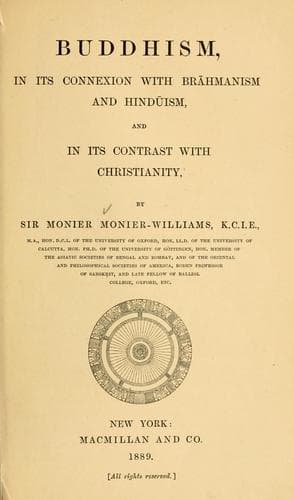
Buddhism, in Its Connexion with Brahmanism and Hinduism, and in Its Contrast with ChristianityMonier-Williams, Monier, Sir
Religion
Buddhism, in Its Connexion with Brahmanism and Hinduism, and in Its Contrast with Christianity
Monier-Williams, Monier, Sir
Buddhism; Buddhism -- Relations -- Christianity; Christianity and other religions -- Buddhism; India -- Religion
Buddhism says:—Be righteous by yourselves, and through yourselves, and
for the getting rid of all life in yourselves. Christianity says:—Be
righteous through the power of God’s gift of eternal life in His Son. In
a word, Buddhism founds its morality on self. Christianity founds its
morality on Christ.
The Buddha said to his followers:—Take nothing from me, trust to no one
but to yourselves.
Christ said, and says to us still:—Take all from me; take this free
gift. Put on this spotless robe. Eat this Bread of Life. Drink this
Living Water.
Think you that any one who receives a priceless gift, is likely
willingly to insult the Giver of it? Think you that any one who accepts
a snow-white robe is likely willingly to soil it by impure acts? Think
you that any one who tastes life-giving Bread is likely to relish husks?
or that any one who draws deep draughts at a living Well is likely to
prefer the polluted water of a stagnant pool?
Beware, then, of judging by the mere letter; or, should you insist on so
judging, bear in mind that everywhere the Buddha’s Law is a dead letter,
because the Buddha is dead; just as the Sermon on the Mount would be a
dead letter, if Christ were dead.
Finally, let me say to the admirers of Buddhism:—
If you insist on placing its moral code on the same level with that of
Christianity, ask yourselves one plain question—Who would be the more
likely to lead a godly, righteous, and sober life, a life of moderation
and temperance, a life of holiness and happiness—the man who has learnt
his morality from the dead, the extinct Buddha, or the man who draws his
morality and his holiness from the living, the eternal, the life-giving
Christ?
LECTURE VII.
_Changes in Buddhism and its disappearance from India._
In the preceding Lectures I have confined myself chiefly to the
consideration of what may be called _true Buddhism_ as taught by its
Founder and developed by his immediate followers and disciples during
the first two or three centuries of its existence in the land of its
birth, India.
To attempt an explanation of all the subsequent phases of Buddhism
would, as I have before stated, require the command of unlimited time.
All I can hope to accomplish in the concluding Lectures is to give a
very general idea of the nature of the changes Buddhism underwent before
it died out in India, and of its corruptions in some of the countries
bordering on India and in North-eastern Asia.
And I may add that those who desire correct views on this subject, ought
not to trust to mere inferences and theories founded on a critical
perusal of the so-called Sacred Books of the Buddhists. For it is
certain that without any practical experience of what Buddhism has
become in modern times—I mean such an experience as can only be gained
by residing or travelling in countries where Buddhism now prevails—the
mere study of its ancient scriptures is likely to be misleading.
Public-domain text, read in full here on John Shaqi.
Reviews
Reviews
No reviews yet
Be the first to share your thoughts on this work.
Elsewhere in the archive
Join the Discussion
Join the discussion
Sign in to leave a comment or review.
Sign InorCreate an account