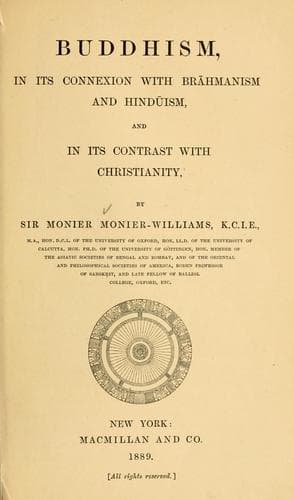
Buddhism, in Its Connexion with Brahmanism and Hinduism, and in Its Contrast with ChristianityMonier-Williams, Monier, Sir
Religion
Buddhism, in Its Connexion with Brahmanism and Hinduism, and in Its Contrast with Christianity
Monier-Williams, Monier, Sir
Buddhism; Buddhism -- Relations -- Christianity; Christianity and other religions -- Buddhism; India -- Religion
He must not take, make, or hoard money. He is forbidden to store up a
money-balance in a worldly bank, but he is urged to be constantly
accumulating a merit-balance in the bank of Karma.
In conclusion, let the Buddha enforce his own moral teaching in his own
way, by allegory and illustration drawn from real life:—When asked by a
Brāhman ‘why he did not plough and sow and earn his own bread?’ he
replied to the following effect: ‘I do plough and sow and eat immortal
fruit (Amata = Amṛita); my plough is wisdom (paṇṇā); my shaft is
modesty; my draught-ox, exertion; my goad, earnest meditation (sati); my
mind, the rein. Faith (saddhā) in the doctrine is the seed I sow;
cleaving to life is the weed I root up; truth is the destroyer of the
weed; Nirvāṇa and deliverance from misery are my harvest.’
(Kasi-bhāradvāja-sutta of the Sutta-nipāta.)
This may be compared with St. Luke viii. 11-15; but have we not here a
contrast rather than a comparison?
Perhaps some may think that the contrast is not unfavourable to
Buddhism. Nay, possibly some may complain that I have not enlarged
sufficiently on the remarkable resemblance between certain moral
precepts in the Buddhist code and in the Christian. I admit this
resemblance—I admit that both tell us:—not to love the world; not to
love money; not to show enmity towards our enemies; not to do
unrighteous or impure acts—to overcome evil by good, and to do to others
as we would be done by.
Nay, I admit even more:—I allow that some Buddhist precepts go beyond
the corresponding Christian injunctions. For Buddhism prohibits all
killing—even of animals and noxious insects. It demands total abstinence
from stimulating drinks—disallowing even moderation in their use. It
excludes all who aim at perfect sanctity from the holy estate of
matrimony. It bids a man, if he strives after perfection, abandon the
world and lead a life of monkhood. In fine, its morality is essentially
a monkhood-morality. It enjoins total abstinence, because it dares not
trust human beings to be temperate. How indeed could it trust them when
it promises them no help, no divine grace, no restraining power?
The glory of Christianity is that having freely given that grace and
that power to man, it trusts him to make use of the gift. It seems to
speak to him thus:—Thy Creator wills to trust thee and to be trusted by
thee; He has endowed thee with freedom of choice, and therefore respects
thy liberty of action. He imposes no rule of total abstinence in regard
to natural desires; He simply bids thee keep them within bounds, so that
thy moderation may be known unto all men; He places thee in the world
amid trials and temptations and says to thee, ‘My grace is sufficient
for thee’ and by its aid thou mayest overcome them all.
Yes, the grand difference between the morality of Buddhism and the
morality of Christianity is not in the letter of the precepts, but in
the principle and motive power brought to bear on their application.
Public-domain text, read in full here on John Shaqi.
Reviews
Reviews
No reviews yet
Be the first to share your thoughts on this work.
Elsewhere in the archive
Join the Discussion
Join the discussion
Sign in to leave a comment or review.
Sign InorCreate an account