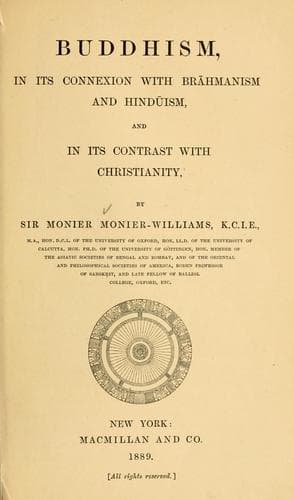
Buddhism, in Its Connexion with Brahmanism and Hinduism, and in Its Contrast with ChristianityMonier-Williams, Monier, Sir
Religion
Buddhism, in Its Connexion with Brahmanism and Hinduism, and in Its Contrast with Christianity
Monier-Williams, Monier, Sir
Buddhism; Buddhism -- Relations -- Christianity; Christianity and other religions -- Buddhism; India -- Religion
It will be seen that the most remarkable feature of the Buddha’s
teaching, so far as it has been stated in the preceding Lectures, was
that he altogether ignored the existence in human nature of any
spiritual aspirations, affections, or instincts higher than or distinct
from the natural aspirations, affections, and instincts of humanity; and
of any force outside of human nature capable of aiding a man’s own
efforts in his struggle for salvation. Not that he reviled, or poured
contempt on the religion prevalent among his fellow-countrymen, but that
he found no place in his system for an external Ruler and Controller of
the Universe, and would have stultified his own teaching had he
acknowledged a Supreme Creator, guiding and upholding all things by His
will, and always at hand to co-operate with His creatures and listen to
their supplications.
If it were possible, in short, to condense into a categorical statement
the scattered utterances of a man whose teaching was rarely dogmatic, we
might affirm that it was to the effect that for any man to depend on a
Being higher than himself, or to centre the noblest affections of his
nature on a merciful, just, and holy God, whose presence he yearned for,
whose aid he prayed for, and to whose image he longed to be
assimilated—was a mere delusion, though perhaps a harmless one. He
therefore set aside every supposed supernatural revelation as useless
and incapable of proof. He prescribed no prayer, he enjoined no form of
worship, he established no real church, and instead of a priesthood or
clergy, ordained to aid men in their progress heavenwards or to console
them in the trials of life, he founded an Order of Monks pledged to
denounce human life as not worth living, and bound to abstain from all
participation in human affairs.
It is true that he deserves commendation for having substituted moral
conduct for useless superstitious rites, but his moral code had no other
aim than the suppression of lusts and desires (p. 139, note 2), and his
peculiar stoical philosophy had no other object than the removal of the
ignorance which obstructed the path to true knowledge—the knowledge that
all life is fraught with pain and misery, and not worth perpetuating.
It is admitted, too, that its moral precepts were of a high order; but
it promised man no divine aid in observing them, it supplied him with no
motive power except the selfish hope of benefiting himself in future
states of corporeal existence, and it provided no remedy in case his
attempts to obey its injunctions ended in failure. How, indeed, could it
do any of these things when its only idea of sin was not the infraction
of God’s law, but the commission of an act fraught with evil
consequences to the doer?
Public-domain text, read in full here on John Shaqi.
Reviews
Reviews
No reviews yet
Be the first to share your thoughts on this work.
Elsewhere in the archive
Join the Discussion
Join the discussion
Sign in to leave a comment or review.
Sign InorCreate an account