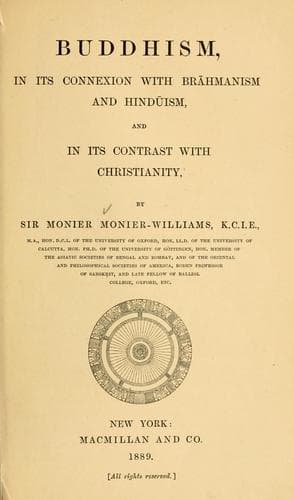
Buddhism, in Its Connexion with Brahmanism and Hinduism, and in Its Contrast with ChristianityMonier-Williams, Monier, Sir
Religion
Buddhism, in Its Connexion with Brahmanism and Hinduism, and in Its Contrast with Christianity
Monier-Williams, Monier, Sir
Buddhism; Buddhism -- Relations -- Christianity; Christianity and other religions -- Buddhism; India -- Religion
Furthermore, it was guilty of the inconsistency of bidding a man cherish
a fellow-feeling for others and diligently engage in all good works,
while it made his true salvation depend on his giving up all love for
wife and children, and setting before himself, as his final goal, a
condition of absolute indifference and inactivity.
What, therefore, I am at present concerned to point out is that, if the
essential doctrines of primitive Buddhism were of the character thus
summarized, a rebound from one extreme to another became inevitable, and
that such a reaction was due to the very nature of the original teaching
of its Founder. In point of fact it was not a development that took
place, but a recoil—like the recoil of a spring held down for a time by
a powerful hand and then released. And this resulted from the simple
working of the eternal instincts of humanity, which insisted on making
themselves felt notwithstanding the unnatural restraint to which the
Buddha had subjected them; so that every doctrine he taught developed by
a kind of irony of fate into a complete contradiction of itself.
Let us take a few examples:—
Buddhism, we know, started with the doctrine that all idea of marriage,
or of happy home-life, was to be abandoned by wise men—by all who aimed
at becoming true Buddhists (in direct contradistinction, we may note, to
the primary Christian truth that it is not good for created man to be
alone, and that therefore his Creator created a help meet for him—a
truth confirmed in a remarkable manner by the Founder of the Christian
Church when He gave the first sign of His divine commission at a
marriage ceremony).
What, then, followed on the Buddha’s original unnatural teaching in
regard to marriage?
Of course an immediate result was that, although according to the
Buddha’s ordinance any one who aimed at perfect sanctity was bound to
lead a celibate life, the rule against marriage was admitted to be
inapplicable to the majority of human beings living in the world. The
mass of the people, in short, were necessarily offenders against the
primary law of Buddhism. Though called lay-Buddhists, they were not
‘wise men’ in the Buddhist sense of the term (pp. 86, 88). There is even
evidence that among certain monkish communities in Northern countries
the law against marriage was soon relaxed. It is well known that at the
present day Lamaseries in Sikkim and Tibet swarm with the children of
monks, though called their nephews and nieces[62]. And far worse than
this, Buddhism ultimately allied itself with Tāntrism or the worship of
the female principle (ṡakti), and under its sanction encouraged the
grossest violations of decency and the worst forms of profligacy.
It was the same in regard to the unnatural vow of poverty. Monasteries
and Lamaseries now possess immense revenues, and monks are often wealthy
men.
Public-domain text, read in full here on John Shaqi.
Reviews
Reviews
No reviews yet
Be the first to share your thoughts on this work.
Elsewhere in the archive
Join the Discussion
Join the discussion
Sign in to leave a comment or review.
Sign InorCreate an account