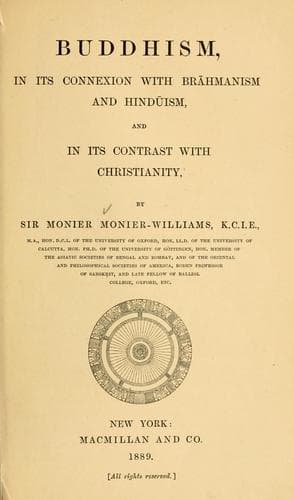
Buddhism, in Its Connexion with Brahmanism and Hinduism, and in Its Contrast with ChristianityMonier-Williams, Monier, Sir
Religion
Buddhism, in Its Connexion with Brahmanism and Hinduism, and in Its Contrast with Christianity
Monier-Williams, Monier, Sir
Buddhism; Buddhism -- Relations -- Christianity; Christianity and other religions -- Buddhism; India -- Religion
Then again, what resulted from the Buddha’s ignoring the existence of a
God, and telling his disciples to abstain from depending on any Being
higher than what man himself could become? Of course this was opposed to
every man’s innermost sense of his own needs and of his own nature. For
man is so constituted that he cannot be happy without loving and
trusting a Being higher than himself—a Being who takes the initiative in
loving His creatures and is the proper object of their loftiest
affections. Nor can man in his secret heart regard either himself or any
one of his fellow-men as a being worthy of his highest adoration. Nor
can he set his affections on a blank or an abstraction. And so, in spite
of the Buddha’s teaching, his followers would act on their own
convictions. They would believe in beings higher than themselves, and in
a personal Creator knowable and lovable by themselves, and knowing and
loving His creatures. Nay, they ultimately converted the Buddha himself
into the very God he denied, calling him ‘The chief god of all the gods’
(Devātideva).
Again, what was the effect of the Buddha’s leading men to believe that
all supernatural revelation was unneeded—that all enlightenment came
from within, and that every man was competent to think out true
knowledge for himself by the exercise of his own reasoning powers, in
the way that the Buddha himself had done?
Of course the result was that the generality of men who shrank from the
effort of thinking out truth for themselves, and were wholly destitute
of any faculty for doing so, insisted on believing in a revelation from
an external power, and ended in attributing infallibility to the
Buddha’s own teaching, and worshipping the Law of Buddhism—as a visible
embodiment of their deceased teacher—with all the ardour of enthusiastic
bibliolatrists.
Furthermore, what followed on the Buddha’s denying that any prayer,
however earnest, could have any power to modify the operation of natural
laws?
Of course men longed for some form of supplication to a higher power,
and so the Buddha’s disciples not only composed prayer-formularies, but
invested the mere letters and syllables of such forms with an efficacy
which no other body of religionists has ever thought of attributing to
prayer of any kind.
They not only repeated mystical sentences, which were called prayers,
though really mere charms, believing that an occult virtue was inherent
in the words, but invented a method of manufacturing such sentences
(Dhāraṇī) like marketable commodities.
They fabricated prayers, in fact, by machinery, inscribing them on
wheels or on rolls inserted in cylinders, which in the present day are
made to revolve by hand or by the force of water and wind, and will
possibly, with the spread of science, be impelled by steam-power, so
that each revolution may count for an infinite number of repetitions,
and be set down to the credit of the owner or manager of the mechanism.
Public-domain text, read in full here on John Shaqi.
Reviews
Reviews
No reviews yet
Be the first to share your thoughts on this work.
Elsewhere in the archive
Join the Discussion
Join the discussion
Sign in to leave a comment or review.
Sign InorCreate an account