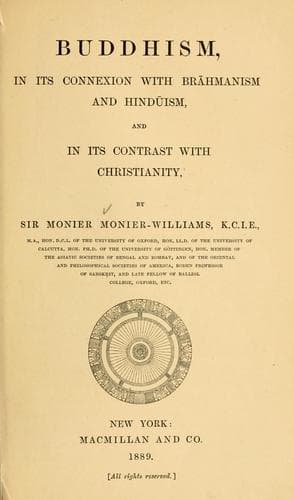
Buddhism, in Its Connexion with Brahmanism and Hinduism, and in Its Contrast with ChristianityMonier-Williams, Monier, Sir
Religion
Buddhism, in Its Connexion with Brahmanism and Hinduism, and in Its Contrast with Christianity
Monier-Williams, Monier, Sir
Buddhism; Buddhism -- Relations -- Christianity; Christianity and other religions -- Buddhism; India -- Religion
The first traveller of whom we have any record was a certain Chinese
Buddhist monk named Fā-hien, who set out on a pilgrimage to India about
the year 399 of our era, with the definite object of searching for and
carrying back to China complete copies of the Vinaya or Rules of
discipline for the Order. He wrote a very simple and straightforward
account of his travels[67]—which lasted for fourteen years—and of his
visits to all the spots in India held most sacred by Buddhists. He was
followed by a Chinese traveller of less mark, named Sang Yun, who
started about 518 A.D., and seems to have ended his journey at Peshawar,
or at least not to have penetrated much further South. Peshawar, we
know, was a great Buddhist centre, and there was a fine Stūpa there,
containing the alms-bowl of Buddha. Then after another interval a much
more celebrated Chinese pilgrim named Hiouen Thsang[68] started for
India (A.D. 629-644). The narrative of his travels for about fifteen
years is perhaps the best known and most commonly quoted of the three.
In Chang Yueh’s preface[69] to these travels Hiouen Thsang is described
as ‘a Doctor of the three Piṭakas, and is said to have translated 657
works from the original Sanskṛit. In all the districts through which he
journeyed he learnt the dialects and investigated the deep secrets of
religion.’
All three travellers give information in regard to the prevalence of
Buddhism in India up to the seventh century of our era, and the
narratives of two—Fā-hien and Hiouen Thsang—are invaluable for the light
they throw on the changes which Buddhism underwent in the interval of
their travels. Here and there the pilgrims exaggerate, especially when
they venture on numerical statistics or write from hearsay; but on the
whole their accounts may be accepted, and we learn that Hiouen Thsang
found some monasteries in ruins which were flourishing in Fā-hien’s
time, and that the Mahā-yāna had supplanted the earlier form of
Buddhism, or rather co-existed with it in many parts of the South as
well as of the North, and was to be found even in Ceylon[70].
And this brings us face to face with the greatest change of all—the
total dying out of Buddhism in the place of its origin. How is it to be
accounted for that no adherents of either the greater or lesser Buddhist
systems—of either the Mahā-yāna or Hīna-yāna—are to be found in India at
the present moment?
The problem is difficult of solution, and I can only offer a few
suggestions for its elucidation.
In the first place, I think it may be confidently asserted that the
disappearance of Buddhism from India was a very gradual process, and
unattended by any serious or violent religious revolution.
We have already alluded to the tolerant, liberal, and eclectic spirit
which has characterized Buddhism ever since the period of its first
promulgation at Benares.
Public-domain text, read in full here on John Shaqi.
Reviews
Reviews
No reviews yet
Be the first to share your thoughts on this work.
Elsewhere in the archive
Join the Discussion
Join the discussion
Sign in to leave a comment or review.
Sign InorCreate an account