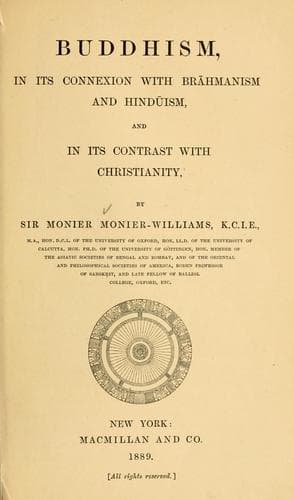
Buddhism, in Its Connexion with Brahmanism and Hinduism, and in Its Contrast with ChristianityMonier-Williams, Monier, Sir
Religion
Buddhism, in Its Connexion with Brahmanism and Hinduism, and in Its Contrast with Christianity
Monier-Williams, Monier, Sir
Buddhism; Buddhism -- Relations -- Christianity; Christianity and other religions -- Buddhism; India -- Religion
Such toleration of the doctrines and ideas of co-existing systems had
its advantages, especially in the early stages of the Buddhistic
movement. It certainly had a prophylactic effect in warding off violent
attacks, and helped to promote the diffusion of Buddhism throughout the
numerous countries to which it ultimately spread. In India itself, as we
have already seen, Buddhism was never aggressive or combative. Its motto
everywhere was persuasion and conciliation. Composure, tranquillity, and
absence of acrimony were stamped on all its features. The very
foundation on which it was reared—the very establishment of a celibate
monastic Order, by means of which true knowledge was to be
propagated—had in it something altogether agreeable to the spirit and
usages of Brāhmanism.
We have seen, too, that the Buddha took care to show his respect for
Brāhmanical traditions, even while promulgating a philosophical theory
and preaching doctrines opposed to all sacerdotalism, priestly
privileges, supernatural revelation, and Vedic ceremonial.
It does not, of course, follow that the great teacher, to whom the
majority of Asiatic races have for centuries looked as their chosen
example, had not the courage of his opinions, and was not competent to
fill the rôle of a religious reformer.
The real fact was that he was too wise to enter upon any open crusade
against inveterate customs and ideas. The peculiar calm of an Indian
atmosphere, though occasionally disturbed by political storms sweeping
from distant regions, has rarely been stirred by violent religious
antagonisms. The various currents of Hindū religious life have flowed
peacefully side by side, and reformers have generally done their work
quietly. As for Gautama, there can be little doubt that his whole career
was stamped with the impress of his early surroundings, and that he
imbibed his tolerant ideas from the Brāhmanism in which he had been
trained.
It has been usual to blame the Brāhmans for their arrogant
exclusiveness, but their arrogance has been rather shown in magnifying
their own caste-privileges and carrying them to an extravagant pitch,
than in preventing any discussion of their own dogmas, or in resenting
any dissent from them.
The very essence of Brāhmanism was tolerance. Every form of opinion was
admissible under a system which made every person and every object in
existence manifestations of the one Being, Brahmă.
The only delicate ground, on which it was dangerous for any reformer to
tread, was caste. The only unpardonable sin was infringement of
caste-rules. Nor was any one tempted to adopt the rôle of a violent
agitator, when all were free to express any opinion they liked without
hindrance, provided they took care to abstain from any act of
interference with caste-privileges.
Public-domain text, read in full here on John Shaqi.
Reviews
Reviews
No reviews yet
Be the first to share your thoughts on this work.
Elsewhere in the archive
Join the Discussion
Join the discussion
Sign in to leave a comment or review.
Sign InorCreate an account