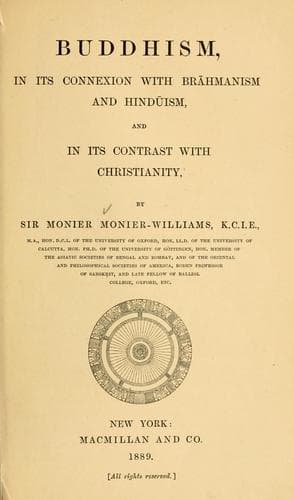
Buddhism, in Its Connexion with Brahmanism and Hinduism, and in Its Contrast with ChristianityMonier-Williams, Monier, Sir
Religion
Buddhism, in Its Connexion with Brahmanism and Hinduism, and in Its Contrast with Christianity
Monier-Williams, Monier, Sir
Buddhism; Buddhism -- Relations -- Christianity; Christianity and other religions -- Buddhism; India -- Religion
Even at Benares, the stronghold of Brāhmanism, I witnessed similar
proofs of amicable mutual intercourse, and at Nāsik—the Benares of
Western India—the proximity of the Buddhist caves and ruined monasteries
which I visited, made it abundantly clear that Brāhmans and Buddhists
agreed to differ and to avoid serious quarrels.
It must nevertheless be admitted, that in the extreme South of India,
and perhaps eventually at Benares and a few other strongholds of
Brāhmanism, the difference between the systems became so accentuated as
to lead to grievous conflicts. Whether blood was shed it is impossible
to prove; but it is alleged, with some degree of probability, that
violent crusades against Buddhism were instituted by Kumārila and
Ṡaṅkara—two well-known Southern Brāhmans noted for their bigotry—in the
seventh and eighth centuries of our era. It does not appear, however,
that they were very successful either in the conversion or extermination
of Buddhists.
It may, I think, be confidently affirmed that what ultimately happened
in most parts of India was, that Vaishṇavas and Ṡaivas crept up softly
to their rival and drew the vitality out of its body by close and
friendly embraces, and that instead of the Buddhists being expelled from
India, Buddhism gradually and quietly lost itself in Vaishṇavism and
Ṡaivism. In fact, by the beginning of the thirteenth century very little
Buddhism remained on Indian soil. In a philosophical drama, called ‘the
Rise of the Moon of Knowledge’ (Prabodha-ćandrodaya), written probably
about the twelfth century, the approaching triumph of Brāhmanism over
Buddhism is clearly indicated; for the Buddhist and other heretical
sects are represented as belonging to the losing side.
Yet, after all, it is scarcely correct to say that Buddhism ever wholly
died away in India. Its name indeed perished there, but its spirit
survived, and its sacred places remain to this day. Its ruined temples,
monasteries, monuments, and idols are scattered everywhere, while some
of these have been perpetuated and adopted by those later phases of
Hindūism which its own toleration helped to bring into existence.
At all events it may be safely affirmed that the passing away of the
Buddhistic system in India was on the whole like the peaceful passing
away of a moribund man surrounded by his relatives, and was at least
unattended with any agonizing pangs[76].
LECTURE VIII.
_Rise of Theistic and Polytheistic Buddhism._
In the preceding Lecture we have endeavoured to show generally how
Buddhism was evolved out of Brāhmanism, how it flourished side by side
with Brāhmanism, and how after a chequered career and protracted
senility in the land of its birth—lasting for at least fifteen
centuries[77]—it ultimately merged its individuality in Vaishṇavism and
Ṡaivism, or, in other words, disappeared and became lost in a composite
system called Hindūism.
Public-domain text, read in full here on John Shaqi.
Reviews
Reviews
No reviews yet
Be the first to share your thoughts on this work.
Elsewhere in the archive
Join the Discussion
Join the discussion
Sign in to leave a comment or review.
Sign InorCreate an account