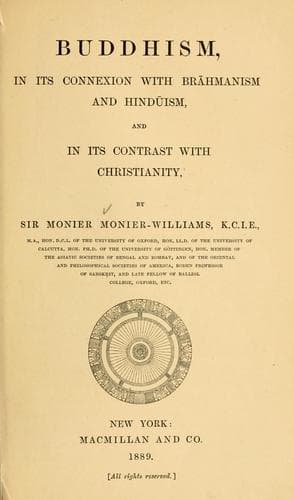
Buddhism, in Its Connexion with Brahmanism and Hinduism, and in Its Contrast with ChristianityMonier-Williams, Monier, Sir
Religion
Buddhism, in Its Connexion with Brahmanism and Hinduism, and in Its Contrast with Christianity
Monier-Williams, Monier, Sir
Buddhism; Buddhism -- Relations -- Christianity; Christianity and other religions -- Buddhism; India -- Religion
‘“On whom dost thou meditate, putting on a pretence of religious
abstraction, yet opening thine eyes? See, saviour that thou art, thou
dost not pity us sick with the shafts of Love. Falsely art thou
compassionate. Who is more cruel than thou?” May Buddha, the conqueror,
who was thus jealously addressed by the Apsarasas (daughters) of Māra
(p. 34), protect you!’
Professor E. B. Cowell has shown in his valuable Preface that both this
play and the sister Hindū play called Ratnāvali were probably put forth
or at least patronised by Harsha-vardhana (Ṡilāditya), and that both
were probably acted at the same period, the king being as much a Hindū
as a Buddhist. Hiouen Thsang praises Harsha-vardhana for his support of
Buddhism, but in his description of the two Convocations held by that
king, states that both Buddhists and Brāhmans were equally honoured by
him, and intimates that half his subjects held one doctrine and half the
other. In the second Convocation which took place at Prayāga (now
Allahābād) eighteen kings were present and 500,000 monks and laymen. On
the first day the statue of Buddha was installed; on the second day that
of the Sun, and on the third that of Ṡiva. Alms were distributed to
Brāhmans and Buddhists alike, and even to the Nirgranthas or Jaina naked
heretics.
Again the well-known play called Mālatī-Mādhava (by Bhava-bhūti, who
lived at Kanauj in the beginning of the eighth century) has an opening
prayer addressed to Ṡiva, and yet a female Buddhist ascetic and her
attendant constitute two of the principal dramatis personæ, proving that
an intermixture of the two creeds prevailed everywhere.
It was also during the reign of Ṡilāditya that the immense monastery at
Nālanda near Rāja-gṛiha formed a seat of learning, which might suggest a
comparison with the learned monkish communities and even with the
universities of mediæval Europe[75]. In that monastery might be seen
several thousand novices and monks of the eighteen Buddhist schools—all
of them supported by royal grants, and thus enabled both to perform
their religious duties, and to prosecute the study of philosophy, law,
and science in literary ease. It is probable that if disputes and
disagreements upon burning questions occurred, they rarely led to
serious conflicts, and were not general throughout India, but confined
to particular localities; and I think it may be safely affirmed that if
Buddhism was ever anywhere persecuted, it never anywhere persecuted in
return.
I myself was much struck in a visit I paid to Ellora in the Nizām’s
territory by the evidence I there saw of the friendly tolerance which
must have prevailed between Brāhmans, Buddhists, and Jains. Brāhmanical,
Buddhist, and Jaina caves are there seen side by side, and their inmates
no doubt lived on terms of fairly friendly tolerance, much as the
members of the Anglican, Roman Catholic, and Wesleyan communions live in
Europe at the present day.
Public-domain text, read in full here on John Shaqi.
Reviews
Reviews
No reviews yet
Be the first to share your thoughts on this work.
Elsewhere in the archive
Join the Discussion
Join the discussion
Sign in to leave a comment or review.
Sign InorCreate an account