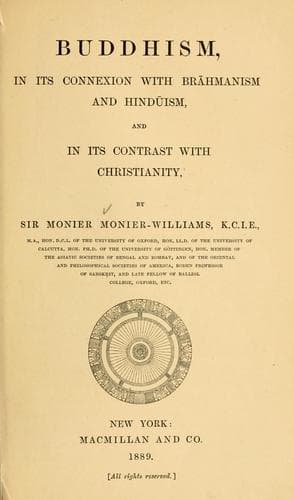
Buddhism, in Its Connexion with Brahmanism and Hinduism, and in Its Contrast with ChristianityMonier-Williams, Monier, Sir
Religion
Buddhism, in Its Connexion with Brahmanism and Hinduism, and in Its Contrast with Christianity
Monier-Williams, Monier, Sir
Buddhism; Buddhism -- Relations -- Christianity; Christianity and other religions -- Buddhism; India -- Religion
In fact, the aspirations of few pious Buddhists in early times ever led
them to soar higher than the happiness of living with Maitreya and
listening to his voice in his own Tushita heaven.
It is true that afterwards when the worship of the Dhyāni-Buddha
Amitābha came into vogue in Northern countries this Buddha’s heaven,
called Sukhāvatī, fabled to be somewhere in the Western sky, seems to
have taken the place of the heaven of Maitreya. But this belongs to a
later phase of Buddhism, to be explained when we speak of the
Dhyāni-Buddhas (p. 203).
It was for Maitreya’s Tushita heaven that Hiouen Thsang, and other
devout men of his day, prayed on their death-beds, and the one Chinese
inscription found at Buddha-Gayā is full of expressions indicative of
the same longing[87].
If then, we are able to enter into the feelings of Buddhists everywhere
in depending on the living, loving, and energizing Maitreya, rather than
on the extinct Buddha who existed only in their memories, we shall find
it less difficult to understand how it came to pass that the idea of, so
to speak, canonizing every great saint or popular head of a monastic
community, and elevating him at death to the position of a Bodhi-sattva
like Maitreya, living in permanent regions of bliss, and able to help
his votaries to the same position, came into vogue.
It may make the course of development of Theistic Buddhism clearer if we
here revert to the early constitution of the Buddhist monastic
brotherhood, and endeavour to show how the homage paid to eminent and
saint-like men led, first to the multiplication of Bodhi-sattvas, and
then to polytheism and every form of polytheistic superstition.
A full explanation of the early monastic system is given in the learned
work of Koeppen[88]. It is clear that as long as Gautama was alive he
was the sole Head of the brotherhood of monks. After his death the
Headship (as in the Christian brotherhood after the death of Christ) was
not assigned to any one leader. The Buddha himself forbade this. The
term Saṇgha at that time merely denoted a republican fraternity of
monks, bound by no irrevocable vows and subject to no hierarchical
Superior, but all intent on following the example, and propagating the
doctrines of their departed leader. Soon, however, the formation of
separate centres of union and teaching became inevitable, and the term
Saṇgha was then applied to each separate society, and sometimes even to
a separate Conclave of each society, as well as to the whole body. It
seems at least certain that each monastic association had the right to
admit monks, to hear confession, and to excommunicate. Naturally, too,
in course of time it became necessary for each society to have some sort
of governing body and choose a kind of president, and this presiding
officer was originally the senior monk, and accordingly had the simple
title of Sthavira (Thera), ‘Elder.’ This title appears to have been
introduced immediately after Gautama’s death.
Public-domain text, read in full here on John Shaqi.
Reviews
Reviews
No reviews yet
Be the first to share your thoughts on this work.
Elsewhere in the archive
Join the Discussion
Join the discussion
Sign in to leave a comment or review.
Sign InorCreate an account