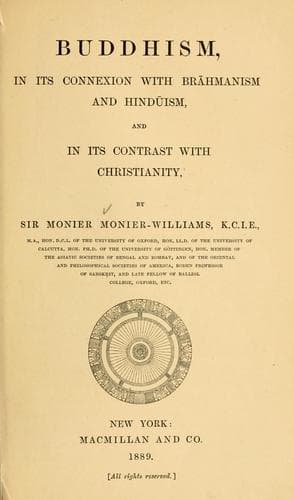
Buddhism, in Its Connexion with Brahmanism and Hinduism, and in Its Contrast with ChristianityMonier-Williams, Monier, Sir
Religion
Buddhism, in Its Connexion with Brahmanism and Hinduism, and in Its Contrast with Christianity
Monier-Williams, Monier, Sir
Buddhism; Buddhism -- Relations -- Christianity; Christianity and other religions -- Buddhism; India -- Religion
It is believed that ever since the time of the great Aṡoka, Sthaviras or
Elders who became actual superintendents of monasteries, exercised
administrative powers, like those of Abbots; each over his own monastic
community. This was the first kind of Headship recognized. It was simply
a superiority of age.
As to any still higher form of authority corresponding to that of Pope,
Archbishop, or Bishop, and extending over several monasteries, this did
not belong to early Buddhism or to its earliest developments. Lists of
uninterrupted series of pretended Buddhist Hierarchs exist, but are mere
fanciful fabrications. Nevertheless, it is certainly a historical fact
that along with the superiority of mere age, seniority, and experience,
there rapidly grew up _pari passu_ a superiority of knowledge, learning,
and sanctity, which were generally, though not invariably, combined in
the person of the presiding Elder.
Any one, in fact, who was distinguished for the practice of the highest
degree of meditation, for complete acquaintance with the Law, for
special purity of conduct, and perfect fulfilment of the precepts, was
naturally elevated above the class of ordinary Bhikshus. Such a monk was
from the earliest times dignified by the title Arhat, ‘very reverend,’
i. e. more worthy of honour than the generality. Arhat, in short, was
from the first a name for the higher grade of saint-like Bhikshu. Such a
man, too, before long, was raised to a still higher level in the
estimation of his fellow-monks. He was believed to have delivered
himself from all the consequences of acts, whether bad or good—from all
the fetters (see p. 127) of life, and therefore from all re-birth. He
was even elevated to a still loftier pinnacle. He was believed by his
superstitious admirers to possess unlimited dominion over nature, space,
time, and matter; to be all-seeing, all-powerful, and capable of working
every kind of miracle. Then, of course, at death he passed away in
Pari-nirvāṇa and was, so to speak, canonized. Be it noted, however, that
such canonization was never accorded to an Arhat till after his
departure from the world.
Probably the immediate disciples of Gautama Buddha—that is, his
so-called ‘great pupils’ (see p. 47), were all considered perfect
Arhats. And these perfect Arhats were probably the only saints of the
earliest period of Buddhism. Yet there was one who surpassed them all by
an immeasurable interval, and that one was Gautama Buddha himself. It
was the distinguishing mark of a supreme Buddha that he was infinitely
greater than all other Arhats, because he had not only gained perfect
knowledge himself, but had become the Saviour of the whole world by
imparting to men the knowledge of how they were to save themselves.
Public-domain text, read in full here on John Shaqi.
Reviews
Reviews
No reviews yet
Be the first to share your thoughts on this work.
Elsewhere in the archive
Join the Discussion
Join the discussion
Sign in to leave a comment or review.
Sign InorCreate an account