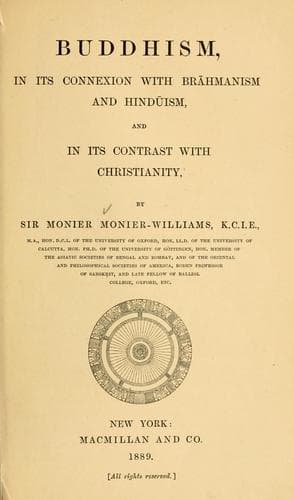
Buddhism, in Its Connexion with Brahmanism and Hinduism, and in Its Contrast with ChristianityMonier-Williams, Monier, Sir
Religion
Buddhism, in Its Connexion with Brahmanism and Hinduism, and in Its Contrast with Christianity
Monier-Williams, Monier, Sir
Buddhism; Buddhism -- Relations -- Christianity; Christianity and other religions -- Buddhism; India -- Religion
All we can say with certainty is, that when Fā-hien visited Mathurā on
the Jumnā 400 years after Christ, their cult certainly existed there at
that time.
We shall not be far wrong if we assert that it was adopted in about the
third century of our era.
As already indicated (see p. 175), the idea of the first Buddhist
triad—the Buddha, the Law, and the Monastic Order—accepted by the
adherents of both Vehicles—was probably derived from the earliest
Brāhmanical triad. (See also Brāhmanism and Hindūism, pp. 9, 44. 74.)
In the same way the second Buddhist triad introduced by the advanced
teachers of the ‘Great Vehicle,’ viz. Mañju-ṡrī, Avalokiteṡvara (=
Padma-pāṇi), and Vajra-pāṇi, corresponded to the later Hindū triad
(tri-mūrti) of deities, Brahmā, Vishṇu, and Ṡiva.
I have explained in ‘Brāhmanism and Hindūism’ (pp. 54, 73) how the gods
Vishṇu and Ṡiva gradually usurped the position of the god Brahmā, whom
they dispossessed of his co-equality with themselves, and how the whole
mythology of the Hindūs, which was originally complicated by a large
admixture of pre-Āryan and Vedic elements, ultimately became more
simplified by arranging itself under the two heads of Vaishṇavism and
Ṡaivism, all other mythological personages being regarded as forms of
either Vishṇu or Ṡiva.
In contradistinction to this, we find that each member of the two
Buddhist triads holds its own, and we are led on to a system which
bewilders us by ever increasing complications—a system which preserves
the individuality of its own triads and deified saints, and yet
recognizes almost all the gods, demigods, demons, and supernatural
beings of Hindūism.
I propose now to offer some account of the development of the Buddhist
Pantheon, beginning with the mythical conceptions peculiar to Buddhism,
and passing on to those held in common with Hindūism.
And first as to the second Buddhist triad above-named, it may be noted,
as a proof of the very gradual growth of Buddhistic mythology, that in
the earlier developments of Buddhism the three Bodhi-sattvas
constituting that triad have very restricted functions.
When I visited the Buddhist caves at Ellora, I noticed that in the
ancient sculptures there, Padma-pāṇi and Vajra-pāṇi (but not Mañju-ṡrī)
are represented as attendants of the human Buddha.
Of course it is easy to understand that the duty of guarding the Buddha
ultimately expanded into that of watching over and protecting the whole
Buddhist world, though it is difficult to determine which of the three
mythical Bodhi-sattvas became first celebrated for the effective
discharge of this duty, or to which of the three chronological
precedence ought to be assigned.
Public-domain text, read in full here on John Shaqi.
Reviews
Reviews
No reviews yet
Be the first to share your thoughts on this work.
Elsewhere in the archive
Join the Discussion
Join the discussion
Sign in to leave a comment or review.
Sign InorCreate an account