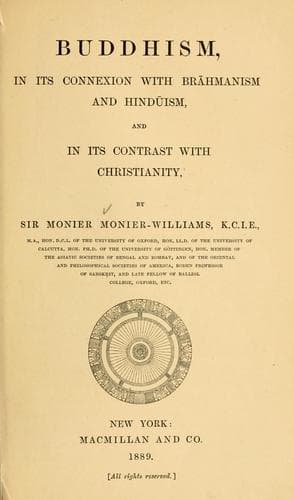
Buddhism, in Its Connexion with Brahmanism and Hinduism, and in Its Contrast with ChristianityMonier-Williams, Monier, Sir
Religion
Buddhism, in Its Connexion with Brahmanism and Hinduism, and in Its Contrast with Christianity
Monier-Williams, Monier, Sir
Buddhism; Buddhism -- Relations -- Christianity; Christianity and other religions -- Buddhism; India -- Religion
And here mention may be made of a modern deified Hindū teacher or sage,
named Gorakh-nāth, who is said to have gone from India into Nepāl, and
is worshipped there as well as at Gorakh-pur and throughout the Panjāb.
Very little is known about him, and he belongs more to Hindūism than to
Buddhism. Some say that he was a contemporary of Kabīr (1488-1512), and,
according to a Janamsākhī, he once had an interview with Nānak, the
founder of the Sikh sect. Such legendary accounts as are current are
wrapped in much mystery. One legend describes him as born from a lotus.
Others describe him as the third or fourth in a series of Ṡaiva
teachers, and the founder of the Kānphāṭā sect of Yogīs. The remarkable
thing about him is that he succeeded in achieving an extraordinary
degree of popularity among Northern Hindūs and among some adherents of
Buddhism in Nepāl. His tomb is in the Panjāb, and he is to this day
adored as a kind of god by immense numbers of the inhabitants of North
Western India under the hills.
But the canonization of such historical teachers in India and their
elevation to semi-divine rank did not satisfy the craving of the
uneducated masses, either among Buddhists or Hindūs, for personal
deities, possessed of powers over human affairs far greater than any
departed human beings, however eminent. In Buddhism the supposed
existence of the more god-like Bodhi-sattva Maitreya—venerated by both
the Mahā-yāna and the Hīna-yāna schools—was not sufficient to satisfy
this craving.
Hence the ‘Great Vehicle’ soon began to teach the existence of numerous
mythological Bodhi-sattvas, other than Maitreya, to whom no historical
character belonged, but whose functions were more divine.
LECTURE IX.
_Theistic and Polytheistic Buddhism._
In the preceding Lecture I have endeavoured to sketch the rise of
theistic and polytheistic Buddhism.
We have now to turn our attention to its development, especially in
regard to the worship of mythical Bodhi-sattvas, and of the Hindū gods
and other mythological beings.
Some of the Bodhi-sattvas of the Mahā-yāna or Great System were merely
quasi-deifications of eminent saints and teachers. Others were
impersonations of certain qualities or forces; and just as in early
Buddhism we have the simple triad of the Buddha, his Law, and his Order,
so in Northern Buddhism the worship of mythical Bodhi-sattvas—other than
Maitreya—was originally confined to a triad, namely (1) Mañju-ṡrī, ‘he
of beautiful glory;’ (2) Avalokiteṡvara, ‘the looking-down lord,’ often
called Padma-pāṇi, ‘the lotus-handed;’ (3) Vajra-pāṇi or Vajra-dhara,
‘the thunderbolt-handed.’
These three mythical Bodhi-sattvas were not known to early Buddhists,
nor to the Buddhists of Ceylon. They are not even found in the oldest
books of the Northern School (such as the Lalita-vistara), though they
occur conspicuously in the Saddharma-puṇḍarīka.
Public-domain text, read in full here on John Shaqi.
Reviews
Reviews
No reviews yet
Be the first to share your thoughts on this work.
Elsewhere in the archive
Join the Discussion
Join the discussion
Sign in to leave a comment or review.
Sign InorCreate an account