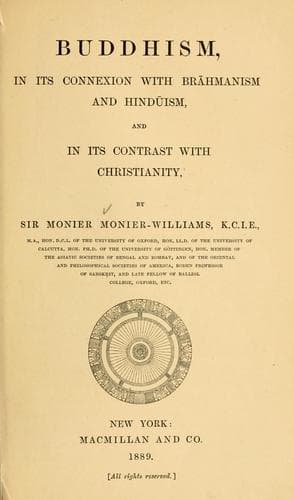
Buddhism, in Its Connexion with Brahmanism and Hinduism, and in Its Contrast with ChristianityMonier-Williams, Monier, Sir
Religion
Buddhism, in Its Connexion with Brahmanism and Hinduism, and in Its Contrast with Christianity
Monier-Williams, Monier, Sir
Buddhism; Buddhism -- Relations -- Christianity; Christianity and other religions -- Buddhism; India -- Religion
As to Vajra-pāṇi (or Vajra-dhara), ‘the thunderbolt-handed,’ this
Bodhi-sattva corresponds in some respects to Indra. He is the fiercest
and most awe-inspiring of all the Bodhi-sattvas, and was, in time,
converted into a kind of Buddhistic form of Ṡiva, resembling that god in
his character of controller of the demon-host and destroyer of evil
spirits. Hiouen Thsang describes how eight Vajra-pāṇis surrounded the
Buddha as an escort, when he journeyed to visit his father Ṡuddhodana.
Vajra-pāṇi is of course a popular object of veneration in all Northern
Buddhist countries, where a dread of malignant spirits is so prevalent
that the waving to and fro of an implement symbolizing a thunderbolt
(Vajra, or in Tibetan Dorje) is practised as a method of keeping them at
bay and averting their malice.
Nevertheless, Vajra-pāṇi is not so popular as the third Bodhi-sattva,
Mañju-ṡrī, ‘he of glorious beauty,’ also called Mañju-ghosha, ‘having a
beautiful voice,’ and Vāgīṡvara, ‘lord of speech.’ This Bodhi-sattva, as
‘wisdom personified,’ and as ‘lord of harmony,’ may be regarded as a
counterpart of the Brāhmanical Brahmā or Viṡva-Karman, the supposed
creator of the universe. Brahmā, however, in his character of chief god,
needed no Buddhistic substitute, having been incorporated by name into
Buddhism. Mañju-ṡrī, as ‘lord of speech,’ seems also to be a counterpart
of Brahmā’s consort Sarasvatī.
According to some, a learned and eloquent Brāhman teacher, named
Mañju-ṡrī, introduced Buddhism from India into Nepāl about 250 years
after the Nirvāṇa of Buddha, and the mythical Mañju-ṡrī may have been a
development of the historical personage. His worship is mentioned by
both Fā-hien and Hiouen Thsang[99], and seems to have been very popular.
A personification of Prajñā pāramitā, ‘transcendent wisdom,’ is also
named. And indeed it seems natural that so soon as the Buddhists began
to personify qualities and invest them with divine attributes, learning
should have been among the first selected for deification, as it was by
the Hindūs in early times.
Mark, however, that the popular Mañju-ṡrī has no place assigned to him
in the Dhyāni-Buddha theory.
This mystical theory was a later development. It may be explained
thus:—The term Dhyāna (Jhāna) is a general expression for the four
gradations of mystic meditation which have ethereal spaces or worlds
corresponding to them (p. 209), and a Dhyāni-Buddha is a Buddha who is
supposed to exist as a kind of spiritual essence in these higher regions
of abstract thought.
Public-domain text, read in full here on John Shaqi.
Reviews
Reviews
No reviews yet
Be the first to share your thoughts on this work.
Elsewhere in the archive
Join the Discussion
Join the discussion
Sign in to leave a comment or review.
Sign InorCreate an account