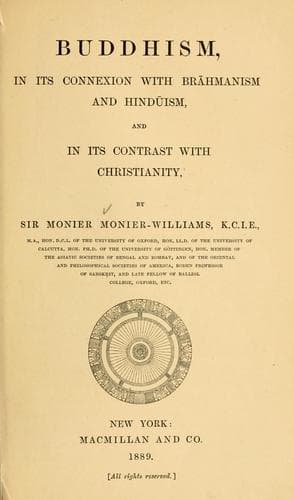
Buddhism, in Its Connexion with Brahmanism and Hinduism, and in Its Contrast with ChristianityMonier-Williams, Monier, Sir
Religion
Buddhism, in Its Connexion with Brahmanism and Hinduism, and in Its Contrast with Christianity
Monier-Williams, Monier, Sir
Buddhism; Buddhism -- Relations -- Christianity; Christianity and other religions -- Buddhism; India -- Religion
With man, speed and rapidity of action are supposed to be the chief
evidences of progress and the chief factors in success. The Evangelist,
on the other hand, is a worker for God and a fellow-worker with God, and
ought not to be discouraged by the tardy advance of the Truth which he
advocates. He may have his moments of despondency, but he has only to
look around and observe that God works everywhere throughout His own
Universe by slow and almost imperceptible processes. The ripe fruit
falls from the tree in a second, but its maturity is not effected
without a whole year of gradual preparation.
LECTURE X.
_Mystical Buddhism in its connexion with the Yoga philosophy._
The first idea implied by Buddhism is intellectual enlightenment. But
Buddhism has its own theory of enlightenment—its own idea of true
knowledge, which it calls Bodhi, not Veda. By true knowledge it means
knowledge acquired by man through his own intellectual faculties and
through his own inner consciousness, instincts, and intuitions, unaided
by any external or supernatural revelation of any kind.
But it is important to observe that Buddhism, in the carrying out of its
own theory of entire self-dependence in the search after truth, was
compelled to be somewhat inconsistent with itself. It enjoined
self-conquest, self-restraint, self-concentration, and separation from
the world for the attainment of true knowledge and for the
accomplishment of its own _summum bonum_—the bliss of Nirvāṇa—the bliss
of deliverance from the fires of passion and the flames of
concupiscence. Yet it encouraged association and combination for mutual
help. It established a universal brotherhood of celibate monks, open to
persons of all castes and ranks, to rich and poor, learned and unlearned
alike—a community of men which might, in theory, be co-extensive with
the whole world—all bound together by the common aim of self-conquest,
all animated by the wish to aid each other in the battle with carnal
desires, all penetrated by a desire to follow the example of the Buddha,
and be guided by the doctrine or law which he promulgated.
Cœnobitic monasticism in fact, as we have already pointed out, became an
essential part of true Buddhism and a necessary instrument for its
propagation.
In all this the Buddha showed himself to be eminently practical in his
methods and profoundly wise in his generation. Evidently, too, he was
wise in abstaining at first from all mystical teaching. Originally
Buddhism set its face against all solitary asceticism and all secret
efforts to attain sublime heights of knowledge. It had no occult, no
esoteric system of doctrine which it withheld from ordinary men.
Public-domain text, read in full here on John Shaqi.
Reviews
Reviews
No reviews yet
Be the first to share your thoughts on this work.
Elsewhere in the archive
Join the Discussion
Join the discussion
Sign in to leave a comment or review.
Sign InorCreate an account