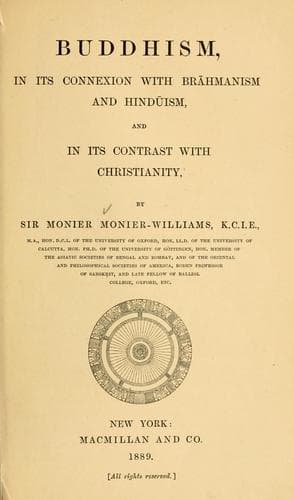
Buddhism, in Its Connexion with Brahmanism and Hinduism, and in Its Contrast with ChristianityMonier-Williams, Monier, Sir
Religion
Buddhism, in Its Connexion with Brahmanism and Hinduism, and in Its Contrast with Christianity
Monier-Williams, Monier, Sir
Buddhism; Buddhism -- Relations -- Christianity; Christianity and other religions -- Buddhism; India -- Religion
Nor did true Buddhism at first concern itself with any form of
philosophical or metaphysical teaching, which it did not consider
helpful for the attainment of the only kind of true knowledge worth
striving for—the knowledge of the origin of suffering and its remedy—the
knowledge that suffering and pain arise from indulging lusts, and that
life is inseparable from suffering, and is an evil to be got rid of by
suppressing self and extinguishing desires.
In the Mahā-parinibbāna-sutta (Rhys Davids, II. 32) is recorded one of
the Buddha’s remarks shortly before his decease:—
‘What, O Ānanda, does the Order desire of me? I have taught the law
(desito dhammo) without making any distinction between esoteric and
exoteric doctrine (anantaram abahiram karitvā). In the matter of the
law, the Tathāgata (i.e. the Buddha) has never had the closed fist of a
teacher (āćariya-muṭṭhi)—of a teacher who withholds some doctrines and
communicates others.’ In short, he was opposed to mysticism.
Nevertheless, admitting, as we must, that early Buddhism had no
mysteries reserved for a privileged circle, we must not shut our eyes to
the fact that the great importance attached to abstract meditation in
the Buddhist system could not fail in the end to encourage the growth of
mystical ideas.
Furthermore, it is undeniable that such ideas were, in some countries,
carried to the most extravagant extremes. Efforts to induce a
trance-like or hypnotic condition, by abstracting the thoughts from all
bodily influences, by recitation of mystical sentences, and by
superstitious devices for the acquisition of supernatural faculties,
were placed above good works and all the duties of the moral code.
We might point, too, to the strange doctrine which arose in Nepāl and
Tibet—the doctrine of the Dhyāni-Buddhas (or ‘Buddhas of
Meditation’)—certain abstract Essences existing in the formless worlds
of thought, who were held to be ethereal and eternal representatives of
the transitory earthly Buddhas. These have been adverted to in a
previous Lecture (see p. 202).
Our present concern is rather with the growth and development of
mystical Buddhism in India itself, through its connexion with the system
of philosophy called Yoga and Yogāćāra.
The close relationship of Buddhism to that system is well known; but the
various practices included under the name Yoga did not owe their origin
to Buddhism. They were prevalent in India before Gautama Buddha’s time;
and one of the most generally accepted facts in his biography is that,
after abandoning his home and worldly associations, he resorted to
certain Brāhman ascetics, who were practising Yoga.
What then was the object which these ascetics had in view?
Public-domain text, read in full here on John Shaqi.
Reviews
Reviews
No reviews yet
Be the first to share your thoughts on this work.
Elsewhere in the archive
Join the Discussion
Join the discussion
Sign in to leave a comment or review.
Sign InorCreate an account