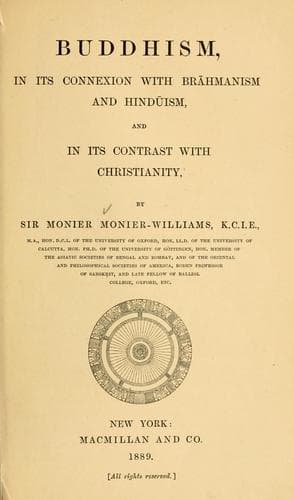
Buddhism, in Its Connexion with Brahmanism and Hinduism, and in Its Contrast with ChristianityMonier-Williams, Monier, Sir
Religion
Buddhism, in Its Connexion with Brahmanism and Hinduism, and in Its Contrast with Christianity
Monier-Williams, Monier, Sir
Buddhism; Buddhism -- Relations -- Christianity; Christianity and other religions -- Buddhism; India -- Religion
In the fifth century B.C., when Gautama Buddha began his career, the
later and lower form of Yoga seems to have been little known.
Practically, in those days, earnest and devout men craved only for union
with the Supreme Being, and absorption into his Essence. Many methods of
effecting such union and absorption were contrived. And these may be
classed under two chief heads—bodily mortification (tapas) and abstract
meditation (dhyāna).
By either one of these two chief means, the devotee was supposed to be
able to get rid of all bodily fetters—to be able to bring his bodily
organs into such subjection to the spiritual that he became unconscious
of possessing any body at all. It was in this way that his spirit became
fit for blending with the Universal Spirit, of which it was originally a
part.
We learn from the Lalita-vistara that various forms of bodily torture,
self-maceration, and austerity were common in Gautama’s time.
Some devotees, we read, seated themselves in one spot and kept perpetual
silence, with their legs bent under them. Some ate only once a day or
once on alternate days, or at intervals of four, six, or fourteen days.
Some slept in wet clothes or on ashes, gravel, stones, boards, thorny
grass, or spikes, or with the face downwards. Some went naked, making no
distinction between fit or unfit places. Some smeared themselves with
ashes, cinders, dust, or clay. Some inhaled smoke and fire. Some gazed
at the sun, or sat surrounded by five fires, or rested on one foot, or
kept one arm perpetually uplifted, or moved about on their knees instead
of on their feet, or baked themselves on hot stones, or submerged
themselves in water, or suspended themselves in air.
Then, again, a method of fasting called very painful (atikṛiććhra),
described by Manu (XI. 213), was often practised. It consisted in eating
only a single mouthful every day for nine days, and then abstaining from
all food for the three following days.
Another method, called the lunar fast (VI. 20, XI. 216), consisted in
beginning with fifteen mouthfuls at full moon, and reducing the quantity
by one mouthful till new moon, and then increasing it again in the same
way till full moon.
Passages without number might be quoted from ancient literature to prove
that similar practices were resorted to throughout India, with the
object of bringing the body into subjection to the spirit. And these
practices have continued up to the present day.
A Muhammadan traveller, whose narrative is quoted by Mr. Mill (British
India, i. 355), once saw a man standing motionless with his face towards
the sun.
The same traveller, having occasion to revisit the same spot sixteen
years afterwards, found the very same man in the very same attitude. He
had gazed on the sun’s disk till all sense of external vision was
extinguished.
Public-domain text, read in full here on John Shaqi.
Reviews
Reviews
No reviews yet
Be the first to share your thoughts on this work.
Elsewhere in the archive
Join the Discussion
Join the discussion
Sign in to leave a comment or review.
Sign InorCreate an account