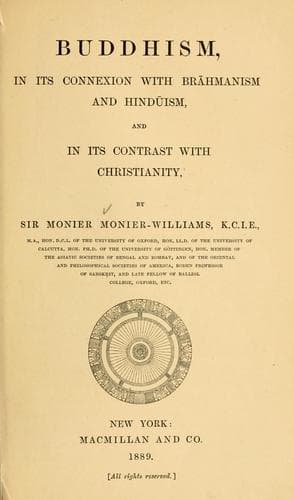
Buddhism, in Its Connexion with Brahmanism and Hinduism, and in Its Contrast with ChristianityMonier-Williams, Monier, Sir
Religion
Buddhism, in Its Connexion with Brahmanism and Hinduism, and in Its Contrast with Christianity
Monier-Williams, Monier, Sir
Buddhism; Buddhism -- Relations -- Christianity; Christianity and other religions -- Buddhism; India -- Religion
The word Yoga literally means ‘union’ (as derived from the Sanskṛit root
‘yuj,’ to join; compare the English word ‘yoke’), and the proper aim of
every man who practised Yoga was the mystic union (or rather re-union)
of his own spirit with the one eternal Soul or Spirit of the Universe. A
true Yogī, says the Bhagavad-gītā (VI. 13, 25), should be indifferent to
all earthly things. To him a clod, a stone, and gold should be all
alike.
Doubtless this was the Buddha’s first aim when he addressed himself to
Yoga in the fifth century B.C., and even to this hour, earnest men in
India resort to this system with the same object.
In the Indian Magazine for July, 1887 (as well as in my ‘Brāhmanism and
Hindūism,’ p. 529), is a short biography of a quite recent religious
reformer named Svāmī Dayānanda-Sarasvatī, whose acquaintance I made at
Bombay in 1876 and 1877, and who only died in 1883. The story of his
life reads almost like a repetition of the life of Buddha, though his
teaching aimed at restoring the supposed monotheistic doctrine of the
Veda.
It is recorded that his father, desiring to initiate him into the
mysteries of Ṡaivism, took him to a shrine dedicated to the god Ṡiva;
but the sight of some mice stealing the consecrated offerings, and of
some rats playing on the heads of the idol, led him to disbelieve in
Ṡiva-worship as a means of union with the Supreme Being. Longing,
however, for such union and for emancipation from the burden of repeated
births, he resolved to renounce marriage and abandon the world.
Accordingly, at the age of twenty-two, he clandestinely quitted his
home, the darkness of evening covering his flight. Taking a secret path,
he travelled thirty miles during the night. Next day he was pursued by
his father, who tried to force him to return, but in vain. After
travelling farther and farther from his native province, he took a vow
to devote himself to the investigation of truth. Then he wandered for
many years all over India, trying to gain knowledge from sages and
philosophers, but without any satisfactory result, till finally he
settled at Ahmedābād. There, having mastered the higher Yoga system, he
became the leader of a new sect called the Ārya-Samāj.
And here we may observe that the expression ‘higher Yoga’ implies that a
lower form of that system had been introduced. In point of fact, the
Yoga system grew, and became twofold—that is, it came in the end to have
two objects.
The earlier was the higher Yoga. It aimed only at union with the Spirit
of the Universe. The more developed system aimed at something more. It
sought to acquire miraculous powers by bringing the body under control
of the will, and by completely abstracting the soul from body and mind,
and isolating it in its own essence. This condition is called Kaivalya.
Public-domain text, read in full here on John Shaqi.
Reviews
Reviews
No reviews yet
Be the first to share your thoughts on this work.
Elsewhere in the archive
Join the Discussion
Join the discussion
Sign in to leave a comment or review.
Sign InorCreate an account