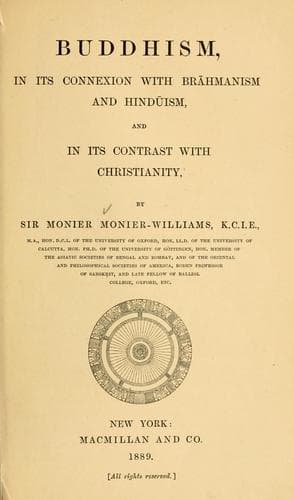
Buddhism, in Its Connexion with Brahmanism and Hinduism, and in Its Contrast with ChristianityMonier-Williams, Monier, Sir
Religion
Buddhism, in Its Connexion with Brahmanism and Hinduism, and in Its Contrast with Christianity
Monier-Williams, Monier, Sir
Buddhism; Buddhism -- Relations -- Christianity; Christianity and other religions -- Buddhism; India -- Religion
As to the muttering of prayers, the repetition of mystic syllables such
as Om (a symbol for the Triad of gods), or of any favourite deity’s
name, is held among Hindūs to be highly efficacious[107]. In a similar
manner among Tibetan Buddhists the six-syllabled sentence: ‘Om maṇi
padme Hūm’—‘Om! the jewel in the lotus! Hūm!’—is used as a charm against
the sixfold course of transmigration (see pp. 121, 371-373).
Mystical syllables are very common. Sir A. Cunningham gives the
following as current in Ladāk:—Bhyo, Rakmo-bhyo! Rakmo-bhyo-bhyo! Ru-lu,
Ru-lu, Hūm Bhyo Hūm! (Ladāk, 386.)
Other mystical syllables (such as Sam, Yam, Ram, Lam, etc.) are supposed
to contain some occult virtue.
The third requisite—posture—would appear to us a somewhat trivial aid to
the union of the human spirit with the divine; but with Hindūs it is an
important auxiliary, fraught with great benefit to the Yogī.
The alleged reason is that certain sitting postures (āsana) and cramping
of the lower limbs are peculiarly efficacious in producing bodily
quietude and preventing restlessness. Some of the postures have curious
names, for example:—Padmāsana, ‘the lotus posture;’ ‘vīrāsana, ‘the
heroic posture;’ siṉhāsana, ‘the lion posture’ (see note, p. 336);
kūrmāsana, ‘tortoise posture;’ kukku-ṭāsana, ‘cock posture;’
dhanur-āsana, ‘bow posture;’ mayūrāsana, ‘peacock posture.’ In the first
the legs are folded under the body and the right foot is placed on the
left thigh, and the left on the right thigh.
In short, the idea is that compression of the lower limbs, in such a way
as to prevent the possibility of the slightest movement, is most
important as a preparation for complete abstraction of soul.
Then, as another aid, particular mystical twistings (called mudrā) of
the upper limbs—of the arms, hands, and fingers—are enjoined.
Even in Muhammadan countries certain movements of the limbs are
practised by devotees with the view of uniting the human spirit with the
Divine. Those who have seen the whirling and ‘howling’ dervishes at
Cairo can testify that fainting fits result from their violent
exertions, inspirations, expirations, and utterances of the name of God,
and such fits are believed to be ecstatic states of union with the
Deity.
The fourth requisite—regulation and suppression of the breath—is perhaps
the one of all the eight which is most difficult for Europeans to
understand or appreciate; yet with Hindūs it is all-important. It is
sometimes called Haṭha-vidyā. Nor are the ideas connected with it wholly
unknown in Europe.
According to Swedenborg[108], thought commences and corresponds with
respiration:—
‘When a man thinks quickly his breath vibrates with rapid alternations;
when the tempest of anger shakes his mind his breath is tumultuous; when
his soul is deep and tranquil, so is his respiration.’ And he adds: ‘It
is strange that this correspondence between the states of the brain or
mind and the lungs has not been admitted in science.’
Public-domain text, read in full here on John Shaqi.
Reviews
Reviews
No reviews yet
Be the first to share your thoughts on this work.
Elsewhere in the archive
Join the Discussion
Join the discussion
Sign in to leave a comment or review.
Sign InorCreate an account