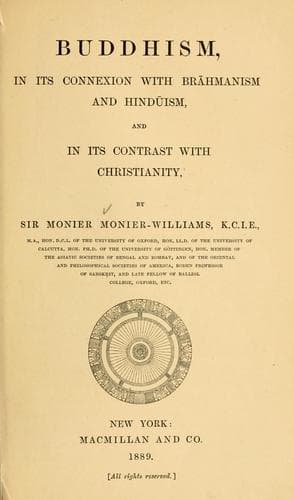
Buddhism, in Its Connexion with Brahmanism and Hinduism, and in Its Contrast with ChristianityMonier-Williams, Monier, Sir
Religion
Buddhism, in Its Connexion with Brahmanism and Hinduism, and in Its Contrast with Christianity
Monier-Williams, Monier, Sir
Buddhism; Buddhism -- Relations -- Christianity; Christianity and other religions -- Buddhism; India -- Religion
The Hindū belief certainly is that deep inspirations of breath assist in
concentrating and abstracting the thoughts and preventing external
impressions. But, more than this, five sorts of air are supposed to
permeate the human body and play an important part in its vitality. They
are called Prāṇa, Vyāna, Apāna, Samāna, Udāna. In the Ćhāndogya
Upanishad (V. 19, etc.) they are described as if they were divine beings
to be adored and to be honoured by offerings of food. The Haṭha-dīpikā
says: ‘As long as the air remains in the body, so long life remains.
Death is the exit of the breath. Hence the air should be retained in the
body.’
In regulating the breath, the air must first be drawn up through one
nostril (the other being closed with the finger), retained in the lungs,
and then expelled through the other nostril. This exercise must be
practised alternately with the right and left nostril. Next, the breath
must be drawn forcibly up through both nostrils, and the air imprisoned
for as long a time as possible in the lungs. Thence it must be forced by
an effort of will towards the internal organs of the body, or made to
mount to the centre of the brain.
The Hindūs, however, do not identify the breath with the soul. They
believe that a crevice or suture called the Brahma-randhram at the top
of the skull serves as an outlet for the escape of the soul at death. A
Hindū Yogī’s skull is sometimes split at death by striking it with a
sacred shell. The idea is to facilitate the exit of the soul. It is said
that in Tibet the hair is torn out of the top of the head, with the same
object.
In the case of a wicked man the soul is supposed to escape through one
of the lower openings of the body.
The imprisonment of the breath in the body by taking in more air than is
necessary for respiration, is the most important of the breath
exercises. It is said that Hindū ascetics, by constant practice, are
able by this means to sustain life under water, or to be buried alive
for long periods of time. Many alleged feats of suspended animation are
of course mere and sheer trickery. It seems, however, open to question,
whether it may not be possible for human beings of particular
constitutions to practise a kind of hibernation like that of animals, or
acquire some power of suspending temporarily the organic functions. A
certain Colonel Townsend is said to have succeeded in doing so.
Public-domain text, read in full here on John Shaqi.
Reviews
Reviews
No reviews yet
Be the first to share your thoughts on this work.
Elsewhere in the archive
Join the Discussion
Join the discussion
Sign in to leave a comment or review.
Sign InorCreate an account