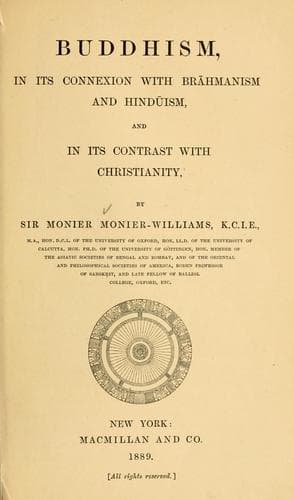
Buddhism, in Its Connexion with Brahmanism and Hinduism, and in Its Contrast with ChristianityMonier-Williams, Monier, Sir
Religion
Buddhism, in Its Connexion with Brahmanism and Hinduism, and in Its Contrast with Christianity
Monier-Williams, Monier, Sir
Buddhism; Buddhism -- Relations -- Christianity; Christianity and other religions -- Buddhism; India -- Religion
The second body is the Sambhoga-kāya, ‘body of conscious bliss,’ which
is of a less ethereal and more material nature than the last. Its
Brāhmanical analogue appears to be the intermediate body (belonging to
departed spirits) called Bhoga-deha, which is of an ethereal character,
though composed of sufficiently gross (sthūla) material particles to be
capable of experiencing happiness or misery.
For observe that it is an essential part of the Hindū doctrine of
transmigration or metempsychosis, that a soul _without a body_ is
incapable of feeling either happiness in heaven or pain in hell.
The third body is the Nirmāṇa-kāya, ‘body of visible shapes and
transformations,’ that is to say, those various concrete material forms
in which every Buddha who exists as an invisible and eternal essence, is
manifested on the earth or elsewhere for the propagation of the true
doctrine.
The Brāhmanical analogue of this third body appears to be the earthly
gross body, called Sthūla-ṡarīra.
It is evident that the extravagances of mystical Buddhism have their
counterparts in Brāhmanism.
There is a Brāhmanical legend which relates how the great Brāhman sage
Ṡaṅkarāćārya entranced his gross body, and then, having forced out his
soul along with his subtle body, entered the dead body of a recently
deceased king, which he occupied for several weeks.
The Yoga of the Brāhmans, in fact, held that adepts, skilled in occult
science, might throw their gross bodies into a state of unconsciousness,
and by a determined effort of will project or force out the ethereal
body through the pores of the skin, and make this phantasmal form
visible in distant places[110].
And now it is declared to be a fact that a community of Buddhist
‘Brothers’ called Mahātmas, are living at this moment in the deserts of
Tibet, who, having emancipated their interior selves from physical
bondage by profound abstract meditation, have acquired ‘astral’ bodies
(distinct from their gross bodies), with which they are able to rise in
the air, or move through space, by the mere exercise of will.
Sir Edwin Arnold on the other hand, in his ‘India Revisited’ (p. 273),
states that he asked Ṡrī Weligama of Ceylon whether there existed
anywhere Mahātmas, who elevated in this way above humanity, possessed
larger powers and more profound insight than any other living
philosophers? Weligama answered, ‘No! such do not exist; you would seek
them vainly in this island, or in Tibet, or in Siam, or in China. It is
true, O my friend, that if we had better interpretations of the Lord
Buddha’s teaching, we might reach to heights and depths of power and
goodness now quite impossible, but we have fallen from the old wisdom,
and none of us to-day are so advanced.’
I believe that the Psychical Research Society once sent delegates to
India who inquired into this subject, and exposed the absurdity of some
of the alleged phenomena.
Public-domain text, read in full here on John Shaqi.
Reviews
Reviews
No reviews yet
Be the first to share your thoughts on this work.
Elsewhere in the archive
Join the Discussion
Join the discussion
Sign in to leave a comment or review.
Sign InorCreate an account