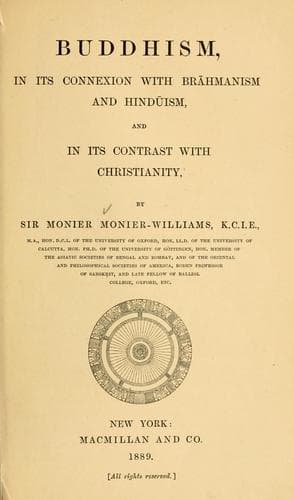
Buddhism, in Its Connexion with Brahmanism and Hinduism, and in Its Contrast with ChristianityMonier-Williams, Monier, Sir
Religion
Buddhism, in Its Connexion with Brahmanism and Hinduism, and in Its Contrast with Christianity
Monier-Williams, Monier, Sir
Buddhism; Buddhism -- Relations -- Christianity; Christianity and other religions -- Buddhism; India -- Religion
The seventh and eighth requisites—viz. internal self-contemplation and
intense self-concentration—are held (when conjoined with the sixth) to
be most important as leading to the acquisition of certain supernatural
powers, of which the following are most commonly enumerated:—(1) Animan,
‘the faculty of reducing the body to the size of an atom;’ (2) Mahiman,
or Gariman, ‘increasing the size or weight at will;’ (3) Laghiman,
‘making the body light at will;’ (4)Prāpti, ‘reaching or touching any
object or spot, however apparently distant;’ (5) Prākāmya, ‘unlimited
exercise of will;’ (6) Īṡitva, ‘gaining absolute power over one’s self
and others;’ (7) Vaṡitā, ‘bringing the elements into subjection;’ (8)
Kāmāvasāyitā, ‘the power of suppressing all desires.’
A Yogī who has acquired these powers can rise aloft to the skies, fly
through space, pass through the key-hole of a door, pierce the mysteries
of planets and stars, cause storms and earthquakes, understand the
language of animals, ascertain what occurs in any part of the world, or
of the universe, recollect the events of his own previous lives, prolong
his present life, see into the past and future, discern the thoughts of
others, assume any form he likes, disappear, reappear, and even enter
into another man’s body and make it his own.
Such were some of the extravagant ideas which grew with the growth of
the Yoga system, and were incorporated into the later developments of
Buddhism.
We learn from Mr. Sarat Chandra Dās that in the monastery of Galdan in
Tibet there is at this moment a college specially devoted to the
teaching of Esoteric and Mystical Buddhism; while magic and sorcery are
taught in the monasteries founded by Padma-sambhava (see pp. 272, 274,
441).
Of course it was only natural that, with the association of Buddhism
with the later Yoga and Ṡaivism, the Buddha himself should have become a
centre for the growth of supernatural and mystical ideas.
Hence the Buddha is fabled by his followers to have ascended to the
Trayastriṉṡa heaven of Indra, walked on water, stepped from one mountain
to another, and left impressions of his feet on the solid rock. Although
in the Dhamma-pada it is twice declared (254, 255), ‘There is no path
through the air.’
Perhaps the climax was reached when the later doctrine made every Buddha
possess a threefold existence or three bodies, much in the same way as
in Hindūism three bodies are assigned to every being.
The first of the Buddha’s bodies is the Dharma-kāya, ‘body of the Law,’
supposed to be a kind of ethereal essence of a highly sublimated nature
and co-extensive with space. This essence was believed to be eternal,
and after the Buddha’s death, was represented by the Law or Doctrine
(Dharma) he taught. The idea seems to have been invented as an analogue
to Brahman, or the Universal spiritual Essence of Brāhmanism[109].
Public-domain text, read in full here on John Shaqi.
Reviews
Reviews
No reviews yet
Be the first to share your thoughts on this work.
Elsewhere in the archive
Join the Discussion
Join the discussion
Sign in to leave a comment or review.
Sign InorCreate an account