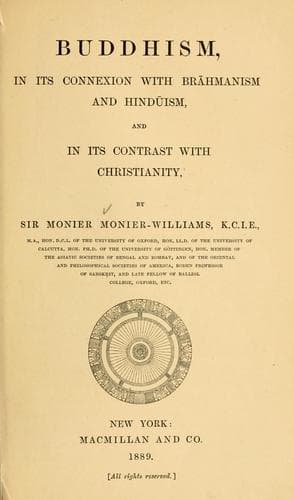
Buddhism, in Its Connexion with Brahmanism and Hinduism, and in Its Contrast with ChristianityMonier-Williams, Monier, Sir
Religion
Buddhism, in Its Connexion with Brahmanism and Hinduism, and in Its Contrast with Christianity
Monier-Williams, Monier, Sir
Buddhism; Buddhism -- Relations -- Christianity; Christianity and other religions -- Buddhism; India -- Religion
The connexion, however, of similar phenomena with feats of conjuring is
undeniable. In the Asiatic Monthly Journal (March, 1829), an account is
given of a Brāhman who poised himself _apparently_ in the air, about
four feet from the ground, for forty minutes, in the presence of the
Governor of Madras. Another juggler sat on three sticks put together to
form a tripod. These were removed, one by one, and the man remained
sitting in the air[112].
Long ago Friar Ricold related that ‘a man from India was said to fly.
The truth was that he did walk close to the surface of the ground
without touching it, and would seem to sit down without any substance to
support him’ (Colonel Yule’s Marco Polo, i. 307).
On the other hand, it is contended, that ‘since we have attained, in the
last half-century, the theory of evolution, the antiquity of man, the
far greater antiquity of the world itself, the correlation of physical
forces, the conservation of energy, spectrum analysis, photography, the
locomotive engine, electric telegraph, spectroscope, electric light, and
the telephone (to which we may now add the phonograph), who shall dare
to fix a limit to the capacity of man[113]?’ Few will deny altogether
the truth of such a contention, however much they may dissent from
Colonel Olcott’s theosophical views.
There may be, of course, latent faculties in humanity which are at
present quite unsuspected, and yet are capable of development in the
future.
According to Sir James Paget, in his recent address on ‘Scientific
Study,’ many things, now held to be inconceivable and past man’s
imagination, are profoundly and assuredly true, and it will be in the
power of Science to prove them to be so[114].
Most persons will assent to these propositions, and at the same time
agree with me when I express my conviction that mystical Buddhism and
Asiatic occultism are no more likely than modern European spiritualism,
to bear the searching light of true scientific investigation.
Nevertheless the subject of mystical Buddhism ought not to be brushed
aside as unworthy of consideration. It furnishes, in my opinion, a
highly interesting topic of inquiry, especially in its bearing on the
‘neo-Buddhism,’ and ‘Theosophy’ of the present day. At all events it is
clear from what we have advanced in the present Lecture, that the
practices connected with spiritualism, mesmerism, animal magnetism,
telepathy, clairvoyance, thought-reading[115], etc., have their
counterparts in the Yoga system prevalent in India more than 2,000 years
ago, and in the practices of mystical Buddhism prevalent in Tibet and
the adjacent countries for many centuries.
‘The thing that hath been, it is that which shall be; and that which is
done is that which shall be done: and there is no new thing under the
sun.’
LECTURE XI.
_Hierarchical Buddhism, especially as developed in Tibet and Mongolia._
Public-domain text, read in full here on John Shaqi.
Reviews
Reviews
No reviews yet
Be the first to share your thoughts on this work.
Elsewhere in the archive
Join the Discussion
Join the discussion
Sign in to leave a comment or review.
Sign InorCreate an account