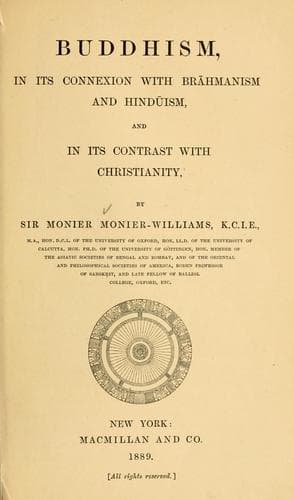
Buddhism, in Its Connexion with Brahmanism and Hinduism, and in Its Contrast with ChristianityMonier-Williams, Monier, Sir
Religion
Buddhism, in Its Connexion with Brahmanism and Hinduism, and in Its Contrast with Christianity
Monier-Williams, Monier, Sir
Buddhism; Buddhism -- Relations -- Christianity; Christianity and other religions -- Buddhism; India -- Religion
Early Buddhism was, as we have seen, opposed to all ecclesiastical
organization. It had no hierarchy in the proper sense of that term—no
church, no priests, no true form of prayer, no religious rites, no
ceremonial observances. It was simply a Brotherhood consisting of men
who had renounced all family ties, all worldly desires—even all desire
for life—and were pledged to devote themselves to meditation, recitation
of the Law, self-restraint, and the accumulation of merit, not for the
sake of saving others, but for their own deliverance.
It was on this account that when the Buddha died he abstained from
appointing a successor, and gave no directions to his followers as to
any particular form of government. All that he said was, ‘Hold fast to
the Law; look not to any one but yourselves as a refuge.’ In short, the
Society (Saṅgha) he left behind was a simple brotherhood of monks which
claimed some kind of corporate authority for the enforcement of
discipline, but had no Head except the Law. Nor did Buddhism for a long
time think of contravening the last injunctions of its Founder. Nor has
it ever attempted to establish a universal hierarchy under one Head and
under one central authority, and although the great Kāṡyapa as president
of the first Council (p. 55) is sometimes held to have been the first
successor of Buddha, and Ānanda the second (p. 56), these men never
claimed any supremacy like that of Popes. In point of fact Buddhism
simply organized itself in separate monastic institutions according to
local ideas and necessities. And indeed the exigencies of healthy
growth, and even the simple instinct of self-preservation compelled the
scattered members of the Buddhist Brotherhood to attempt some such
organization very soon after the death of their Founder. In ancient
times communication was carried on with difficulty, and the Buddhist
Brotherhood could only hold together by combining for mutual support in
various centres, and adopting some sort of monastic government.
It was thus that every collection of monks naturally tended to
crystallize into a distinct organized society with certain definite
rules.
Naturally, the earliest constitution of each was moulded according to
the family pattern. The living Head of every monastery was a kind of
spiritual father, while its inmates were his children, and these, again,
resolved themselves into two classes: the first consisting of the more
youthful members of the society; the second, of those whose more mature
experience entitled them to greater respect and reverence. Then, again,
some kind of pre-eminence was assigned to individuals who were
remarkable for greater knowledge, or sanctity of character.
It is easy to understand, therefore, how it happened that the Saṅgha or
collective community of monks was compelled in the end to establish
several gradations of rank and position among its members.
Public-domain text, read in full here on John Shaqi.
Reviews
Reviews
No reviews yet
Be the first to share your thoughts on this work.
Elsewhere in the archive
Join the Discussion
Join the discussion
Sign in to leave a comment or review.
Sign InorCreate an account