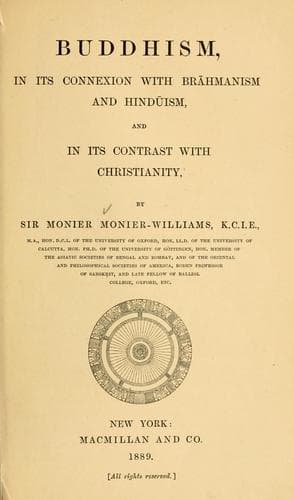
Buddhism, in Its Connexion with Brahmanism and Hinduism, and in Its Contrast with ChristianityMonier-Williams, Monier, Sir
Religion
Buddhism, in Its Connexion with Brahmanism and Hinduism, and in Its Contrast with Christianity
Monier-Williams, Monier, Sir
Buddhism; Buddhism -- Relations -- Christianity; Christianity and other religions -- Buddhism; India -- Religion
The following were soon recognized:—1. The Ṡrāmaṇera or ‘novice’ (who
began by being a Ćhela or ‘pupil’ under education); 2. The Ṡramaṇa (also
called Bhikshu) or full monk; 3. The Sthavira or ‘elder,’ who was merely
superior to others in virtue of his age; 4. The Mahā-sthavira or ‘great
elder’ (sometimes called Sthaviraḥ Sthavirāṇām); 5. The Upādhyāya and
Āćārya. These last were teachers of different kinds, who received honour
in virtue of their knowledge; the two positions of elder and teacher
being frequently united in the President of particular monasteries.
No doubt gradations of this kind existed in very early times in India,
Ceylon, and Burma. But in India the whole Buddhistic Order of monks
passed away.
In Ceylon and Burma, on the contrary, Buddhism has held its own. It may
even now be found in a purer form in those countries and in Siam than in
any other region of Eastern Asia, although it must be borne in mind
that, when it was introduced there, it was grafted on serpent-worship,
Nāga-worship[116], demon-worship, and Nath-worship[117], with all of
which, as well as with the worship of numerous Hindū gods, it continues
to be adulterated in the present day.
The Sinhalese (Koeppen, i. 207, 386) give a list of the first five
successive enforcers of discipline (viz. Upāli, Dāsaka, Sonaka, Siggava,
and Moggali-putta), and another list of ten successive Sthaviras or
elders, beginning with Sāri-putta. These lists are untrustworthy,
especially as omitting the great Kāṡyapa.
And I may here state that the condition of Buddhism in Ceylon is a
subject which I have had an opportunity of investigating personally. I
visited Ceylon in 1877, and had many interesting conversations with
intelligent monks, heads of monasteries, and a few really learned men,
including a leading monk named Sumaṅgala, who described himself to me as
‘High Priest of Adam’s Peak[118].’
I found, too, that a lofty idea prevails in Ceylon in regard to the
status of the monkhood. Theoretically, a true monk is regarded as a kind
of inferior Buddha, and revered accordingly. There are boy-pupils,
novices, and full monks, as in Burma (see p. 259). The
admission-ceremonies resemble those before described (p. 77). Admission
confers no priestly powers. Those monks who are Anglicized by contact
with our civilization call themselves ‘priests,’ but they are not real
priests, and have no sacerdotal functions except teaching, intoning the
Law, and preaching. They live as celibates and cœnobites in Pān-sālās
(‘houses made of leaves,’ p. 430), or monastic buildings of the simplest
structure.
Public-domain text, read in full here on John Shaqi.
Reviews
Reviews
No reviews yet
Be the first to share your thoughts on this work.
Elsewhere in the archive
Join the Discussion
Join the discussion
Sign in to leave a comment or review.
Sign InorCreate an account