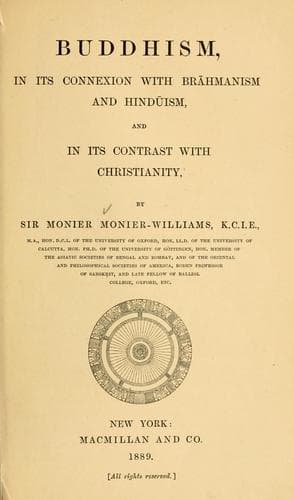
Buddhism, in Its Connexion with Brahmanism and Hinduism, and in Its Contrast with ChristianityMonier-Williams, Monier, Sir
Religion
Buddhism, in Its Connexion with Brahmanism and Hinduism, and in Its Contrast with Christianity
Monier-Williams, Monier, Sir
Buddhism; Buddhism -- Relations -- Christianity; Christianity and other religions -- Buddhism; India -- Religion
Each monastery in Ceylon has a presiding Head, and generally a temple
and library attached, with considerable property in land, but there is
clearly no organized hierarchy in the proper sense of the term, and no
supreme authority like that of an Archbishop; though it is said that the
Heads of the two Kandy Colleges exercise a kind of control over the
after-career of the monks they have trained. I found that a certain
amount of intelligence and learning exists among the monks both at
Colombo and Kandy, but it must be evident to every impartial observer
that the habit of living in houses apart from the laity, of repeating
the Law by rote, and of engaging in a kind of meditation which generally
amounts to thinking about nothing in particular, must tend, in the
majority of instances, to contract the mind, induce laziness, and give a
vacant and listless expression to the countenance. It may be safely
affirmed that the chief religious aim of the Buddhists of Ceylon is to
acquire merit with a view to ‘better’ themselves in future states of
existence, and that their highest aspiration is to attain to the heaven
of Indra (Ṡakra, p. 207). They have no real desire for Nirvāṇa (p. 141),
and still less for Pari-nirvāṇa (p. 142).
Passing on to Burma we may remark that although in Burma, as in Ceylon,
a pure form of Buddhism has prevailed ever since its introduction by
Buddha-ghosha (p. 65), and is still existent, yet we find that the purer
system is mixed up, as in Ceylon, with the worship of Nāgas, demons,
spirit-gods called Naths (commonly spelt Nats, p. 217), and with a kind
of Shamanism derived from the surrounding hill-tribes.
In regard to the gradations of the monkhood a more complete organization
exists in Burma than in Ceylon.
To begin with the boy-pupils:—In Burma nearly all boys become inmates of
monastic houses (called Kyoung) with the one object of learning to read
and write. They are simply school-boys and nothing more. Indeed, until
our advent, the monasteries monopolized the education of the country,
and to a great extent do so still. The real gradations are as follow:—
1. The Sheṅ or Shiṅ, that is Ṡrāmaṇeras or novices. These are properly
youths of at least fifteen years of age (but see p. 307); their hair is
cut off and yellow garments are put on for a time.
It should be noted that every male throughout Burma is required to enter
a monastery and become a novice for a portion of his life, if only for a
single Vassa. This is because the Buddha taught that every true Buddhist
ought to conform to his example and become a monk, although he wisely
abstained from imposing any irrevocable vows. The whole process is often
merely formal, and sometimes only lasts for seven days.
Public-domain text, read in full here on John Shaqi.
Reviews
Reviews
No reviews yet
Be the first to share your thoughts on this work.
Elsewhere in the archive
Join the Discussion
Join the discussion
Sign in to leave a comment or review.
Sign InorCreate an account