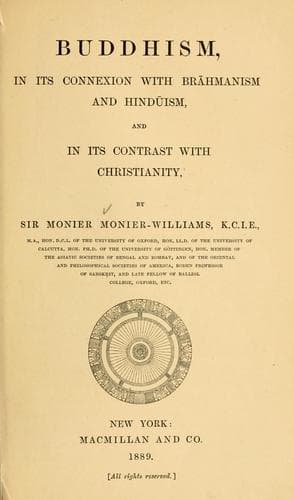
Buddhism, in Its Connexion with Brahmanism and Hinduism, and in Its Contrast with ChristianityMonier-Williams, Monier, Sir
Religion
Buddhism, in Its Connexion with Brahmanism and Hinduism, and in Its Contrast with Christianity
Monier-Williams, Monier, Sir
Buddhism; Buddhism -- Relations -- Christianity; Christianity and other religions -- Buddhism; India -- Religion
2. The Pyit-seṅ or Pyit-siṅ (sometimes pronounced Patzin) or full monks,
who have the title Pungī or Phungī (sometimes spelt Phungee or Phongie),
‘full of great glory,’ when they have been at least ten years members of
the order. They correspond to the Ṡramaṇas, and are by Europeans called
Talapoins (from their carrying fans of palm leaves). Their dress usually
consists of three pieces of yellow cotton cloth.
3. The Hsayā (always a Phungī) or Head of a separate monastery, who
corresponds to the Abbot of European countries.
4. The Gaiṇ-ok or provincial Head, who has a kind of episcopal
jurisdiction over all the monasteries of a district.
5. The Thāthanā-paing (Thāthanā = Sanskṛit Ṡāsanā) or supreme rulers,
who correspond to Archbishops. They superintend all religious affairs.
According to Mr. Scott, there are now eight of them.
Occasionally instances occur of hermit-monks who lead solitary lives,
and sit motionless in meditation for years.
In Siam the gradations of monkhood are nearly similar to those in Burma,
and we learn from Mr. Alabaster that the monastic vow is not binding for
life, but can be cancelled at any time. This rule leads to every Siamese
man spending at least three months of his life in a monastery.
We have now to pass from Ceylon, Burma, and Siam to Tibet (properly
called Bod or Bot or Bhot, Sanskṛit Bhoṭa). And here we leave the
simpler forms of Buddhism and are brought face to face with that highly
developed system which, though nominally resulting from an expansion of
the Hīna-yāna, ‘Little Method,’ into the Mahā-yāna, ‘Great Method’ (p.
158), was really the product of a still further expansion of the ‘Great
Method’ and its combination with other creeds.
In truth, Tibetan Buddhism is so different from every other Buddhistic
system that it ought to be treated of separately in a separate volume,
as Koeppen has done. In his elaborate and excellent work on this subject
he has remarked that for the development of a hierarchy no circumstance
is more favourable than isolation, and that this advantage was offered
in the highest degree by Tibet. Up to the moment of its conversion to
Buddhism a profound darkness had rested on it. The inhabitants were
ignorant and uncultivated, and their indigenous religion, sometimes
called Bon, consisted chiefly of magic based on a kind of Shamanism.
To describe exactly what Shamanism is would be no easy task. The word is
said to be of Tungusic origin[120], and to be used as a name for the
earliest religion of Mongolia, Siberia, and other Northern countries.
Perhaps we shall not be far wrong in asserting that the two principal
constituents of Shamanism are the worship of nature and the dread of
spirits.
Public-domain text, read in full here on John Shaqi.
Reviews
Reviews
No reviews yet
Be the first to share your thoughts on this work.
Elsewhere in the archive
Join the Discussion
Join the discussion
Sign in to leave a comment or review.
Sign InorCreate an account