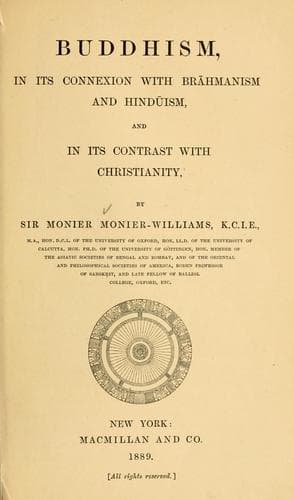
Buddhism, in Its Connexion with Brahmanism and Hinduism, and in Its Contrast with ChristianityMonier-Williams, Monier, Sir
Religion
Buddhism, in Its Connexion with Brahmanism and Hinduism, and in Its Contrast with Christianity
Monier-Williams, Monier, Sir
Buddhism; Buddhism -- Relations -- Christianity; Christianity and other religions -- Buddhism; India -- Religion
It should be noted that when an incarnated Lāma is the spiritual Head of
a monastery there is generally a temporal Head to manage its affairs.
Then we must not forget that Tibetan Buddhism has also its organized
female hierarchy, on the highest steps of which are female Khutuktus and
incarnated Abbesses, as well as lower gradations of nuns and novices,
living together in their own convents.
The rules of discipline for the whole Lāmistic hierarchy fill at least
thirteen out of the 108 volumes of the Tibetan Canon (see p. 272). They
do not differ materially from those of other Buddhist countries. The 253
rules of the Pratimoksha-sūtra (see p. 62) are said to contain commands
and prohibitions relating to five sides of the monastic life—conduct,
dress, food, habitation, and occupation.
It must be borne in mind that early Lāmism, like true Buddhism, had
properly no secular priesthood and encouraged no intercourse with the
outer world, except for the reception of alms and food from the laity.
All grades of the hierarchy were supposed to live together as one
celibate fraternity in monastic seclusion, apart from mundane
associations. Their only duties were to meditate, recite the Law, and
obey certain strict rules of discipline. This strictness of discipline,
however, was not long borne with equal patience by the whole fraternity.
It soon became irksome to a large section, and the same state of things
which arose in early Buddhism and generally arises in all religious
communities, occurred in Lāmism. The fraternity of Lāmas became split up
into two chief parties or sects—the strict and the lax. We shall see in
the end that these two sects were distinguished from each other by the
colour of their garments, and especially of their caps, the former
adopting yellow and calling themselves Gelug pa or Galdan pa, the latter
adopting red (Shamār). Of course the lax or Red-cap sect soon infringed
the rule in regard to celibacy, and allowed the marriage of monks under
certain conditions, though such marriages seem at first to have been
exceptional.
It is said, indeed, that in Nepāl, under modern Gorkha rule, the
celibate occupies a lower position than the married monk, to whom the
services in the temples are committed. It is said, too, that the Lāmas
of Sikkim and other northern countries constantly have children living
with them, though they do not admit them to be their own (p. 152). Yet,
for all that, celibacy is the rule, and nominally, at any rate, the
great majority of Lāmistic monks in Eastern Asia are unmarried
cœnobites, who live together in monasteries.
Certainly in no other country in the world are monasteries so numerous
or on so vast a scale as in Tibet and Mongolia (see p. 426).
Public-domain text, read in full here on John Shaqi.
Reviews
Reviews
No reviews yet
Be the first to share your thoughts on this work.
Elsewhere in the archive
Join the Discussion
Join the discussion
Sign in to leave a comment or review.
Sign InorCreate an account