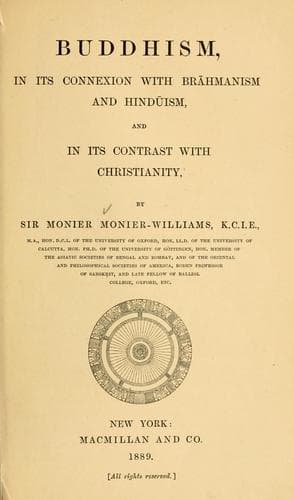
Buddhism, in Its Connexion with Brahmanism and Hinduism, and in Its Contrast with ChristianityMonier-Williams, Monier, Sir
Religion
Buddhism, in Its Connexion with Brahmanism and Hinduism, and in Its Contrast with Christianity
Monier-Williams, Monier, Sir
Buddhism; Buddhism -- Relations -- Christianity; Christianity and other religions -- Buddhism; India -- Religion
And, indeed, in all probability it was the difficulty of enforcing
discipline and order in these immense establishments, without some
method of securing obedience to a presiding Head acceptable to all the
inmates, that led to that strange re-incarnation or ‘Avatāra’ theory
which is one chief distinguishing feature of Lāmism.
The process by which this remarkable theory was developed is so
interesting and so important in relation to the subject of the present
Lecture that it deserves careful investigation, and to clear the ground
we must here make a brief digression and advert to some circumstances in
the early history of Tibet and Mongolia, as given in Koeppen’s laborious
work.
We learn from him that Nya Khri Tsanpo, who lived in the Yarlung valley,
was the first king of Tibet. After several successors came Srong Tsan
Gampo. This king was born in 617, and, according to a legend, exhibited
at his birth certain marks of perfection like those of Amitābha or
Avalokiteṡvara (p. 198). He is worshipped as a great Conqueror and
Reformer.
In the year 632, or about the time when Muhammad died in Arabia, he
began the work of civilizing his subjects. To this end he directed his
minister Thumi (or Thonmi) Sambhoṭa to proceed to India, and make
himself acquainted with Buddhist writings. This great man was the first
to design the Tibetan alphabet on the model of the Indian letters then
in use (called Lañćha), but rejecting certain consonants and certain
vowels as unsuitable for the representation of Tibetan sounds, and
adding six new letters. Hence he was the first to introduce the art of
writing along with Buddhism into Tibet.
It may be noted here that Buddhism, to its great credit, has generally
given some sort of literary education to the barbarous nations to which
it has imparted its own doctrines. It has also made the vernacular of
the people its medium of instruction, though it has not always
translated its sacred literature or ritualistic formularies into that
vernacular.
The first Tibetan author was Thumi Sambhoṭa himself, who is said to have
composed a grammar and other books during his sojourn in India. An
important work translated by him into the vernacular was the Maṇi
Kambum—a Tantra work, alleged to have been revealed by Amitābha and his
son Avalokiteṡvara. This book describes the introduction of Buddhism
into Tibet as well as the origin of the well-known six-syllabled
prayer-formula of Tibet—Om maṇi padme Hūm (see pp. 371-374). It contains
100,000 precepts.
Public-domain text, read in full here on John Shaqi.
Reviews
Reviews
No reviews yet
Be the first to share your thoughts on this work.
Elsewhere in the archive
Join the Discussion
Join the discussion
Sign in to leave a comment or review.
Sign InorCreate an account