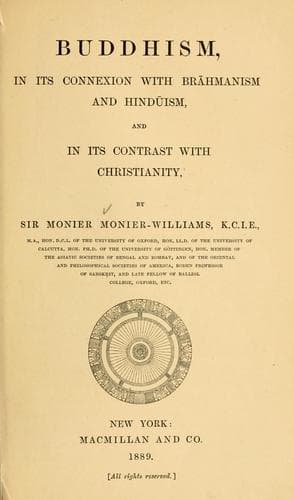
Buddhism, in Its Connexion with Brahmanism and Hinduism, and in Its Contrast with ChristianityMonier-Williams, Monier, Sir
Religion
Buddhism, in Its Connexion with Brahmanism and Hinduism, and in Its Contrast with Christianity
Monier-Williams, Monier, Sir
Buddhism; Buddhism -- Relations -- Christianity; Christianity and other religions -- Buddhism; India -- Religion
Examples of the highest Avatāras are the two quasi-Popes, or spiritual
Kings, who are supreme Lāmas of the Yellow sect—the one residing at
Lhāssa, and the other at Tashi Lunpo (Krashi Lunpo), about 100 miles
distant, in a south-westerly direction, not far from the town of
Shigatse (or Shigatze, capital of the province of Tsang), and not very
far from our Indian frontier.
The Grand Lāma at Lhāssa is the Dalai Lāma, that is, ‘the Ocean-Lāma, or
one whose power and learning are as great as the ocean;’ a half
Mongolian half Tibetan title—Dalai (or Tale) meaning in Mongolian
‘Ocean,’ and Lāma meaning in Tibetan ‘a superior Teacher’ (see note, p.
262). He has also the Tibetan title of rGyamthso Rinpoche (Rin-po-će),
‘Ocean-Jewel’ (the Tibetan equivalent for Dalai being rGyamthso).
The other Grand Lāma who resides in the monastery of Tashi Lunpo, is
known in Europe under the names of the Tashi Lāma (sometimes written
Teshu Lāma) or Panchen Lāma (called in Mongolian Bogdo Lāma). He has the
Tibetan title of Panchen Rinpoche (Pañ-ćen Rin-po-će), ‘the great Paṇḍit
Jewel’ (Pan being equivalent to Paṇḍita, and chen meaning great).
Hence Tashi Lunpo is the second metropolis of Lāmism (see p. 443). It is
said to have been built by Gedun grub pa, the chief pupil of the
Reformer Tsong Khapa, in 1445 (see p. 291).
Neither of these Grand Lāmas are Popes in the European sense, for
neither are elected by a conclave of chief Lāmas.
The belief is that when they quit their bodies at death, they re-appear
after nine months, or occasionally after the second or third year, in
children whose bodies they have occupied from conception.
The Dalai Lāmas are held to be continuous re-incarnations of the
Dhyāni-Bodhisattva Avalokiteṡvara (p. 197), while the Panchen Lāmas are
continuous re-incarnations of his father the Dhyāni-Buddha Amitābha (p.
203).
Hence, as the father is superior to the son, and the master to the
pupil, the Panchen Lāma at Tashi Lunpo might reasonably have ranked
above the Dalai Lāma at Lhāssa. But, as Avalokiteṡvara is the special
patron of the Lāmistic Church in Tibet, his incarnation at Lhāssa is
practically a more important personage than the incarnated Dhyāni-Buddha
at Tashi Lunpo. Some hold that the Panchen Lāma is only a re-incarnation
of Tsong Khapa, who was identified with Mañju-ṡrī.
It is said that the Dalai Lāma exercises secular authority over about
four millions of people, including monks; although in the present day
political power has to a great extent been taken from him by the Chinese
Government, which has two permanent Commissioners or Residents (called
Ampas) at Lhāssa, and sometimes sends a special Envoy (Kin-Tche)[130].
Public-domain text, read in full here on John Shaqi.
Reviews
Reviews
No reviews yet
Be the first to share your thoughts on this work.
Elsewhere in the archive
Join the Discussion
Join the discussion
Sign in to leave a comment or review.
Sign InorCreate an account