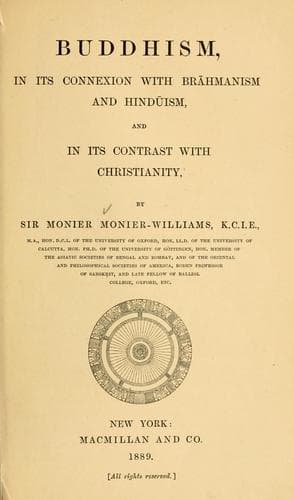
Buddhism, in Its Connexion with Brahmanism and Hinduism, and in Its Contrast with ChristianityMonier-Williams, Monier, Sir
Religion
Buddhism, in Its Connexion with Brahmanism and Hinduism, and in Its Contrast with Christianity
Monier-Williams, Monier, Sir
Buddhism; Buddhism -- Relations -- Christianity; Christianity and other religions -- Buddhism; India -- Religion
The real fact is, that since mere children, who are too young to have
received any education, are elevated to the Grand Lāmaship, and most of
them either die naturally or are made to die before they have gained any
knowledge, the re-incarnated Lāmas are generally unfit to govern, and in
monasteries which have an Avatāra Grand Lāma, an elected chief Lāma acts
as regent or administrator of affairs, while the incarnated Buddha is
supposed to lose himself in sublime heights of meditation and receive
divine homage[131]. This elected Regent also governs during the
intervals of the incarnations, and at Lhāssa he is the real Head and
most powerful Tibetan official. He is called Nomun-khan or Nomin-khan
(or No min han).
The manner in which the Avatāra doctrine is carried into practice has
varied at different times.
It is alleged that formerly the departing Lāma, before he transferred
himself to another body, was in the habit of revealing where and in what
family he would be re-incarnated. Or occasionally it happened that
children of two or three years of age called out suddenly, as if
impelled by some spiritual influence, ‘I am a living Buddha, I am the
chief Lāma of such and such a monastery.’
Or more commonly the sacred books were consulted; or the official
soothsayers gave their opinion.
But the usual rule was that at the death of the Dalai Lāma the
interpretation of the traditions and oracles about his re-birth and the
duty of discovering the family in which he was to appear were committed
to the Panchen Lāma. When the Panchen Lāma himself died, the Dalai Grand
Lāma did the same service for him.
It was only natural that the holy land of Tibet, and especially the holy
city of Lhāssa, should have been most fruitful in re-incarnations, and
should even have supplied foreign countries with them.
When Messrs. Huc and Gabet were travelling in Mongolia they were about
to pass a certain Lāmistic convent without stopping, when a Lāma came
out and invited them to enter, that they might have an opportunity of
paying adoration to the saint enthroned within. ‘Our saint,’ he said,
‘is not a mere man. In our small convent we have the happiness to
possess a living Buddha! Two years ago he deigned to descend from the
holy mountains of Tibet, and he is now seven years old.’ These living
Buddhas, according to M. Huc, are very numerous. Sometimes a clever Lāma
builds a small temple and attracts a few disciples. Then by degrees his
reputation increases. Other Lāmas build their cells near the temple, and
bring it into fashion, and proclaim him to be a living Buddha.
It is said, indeed, that some spiritual Heads of the Hierarchy in Lhāssa
have contrived to instal their illegitimate children in the Headship of
distant Lāmaseries, so that occasionally the supposed living Buddha is
really the son of some Tibetan Grand Lāma.
Public-domain text, read in full here on John Shaqi.
Reviews
Reviews
No reviews yet
Be the first to share your thoughts on this work.
Elsewhere in the archive
Join the Discussion
Join the discussion
Sign in to leave a comment or review.
Sign InorCreate an account