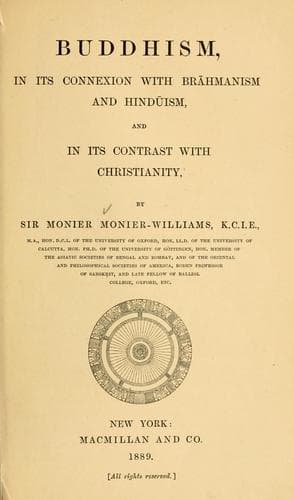
Buddhism, in Its Connexion with Brahmanism and Hinduism, and in Its Contrast with ChristianityMonier-Williams, Monier, Sir
Religion
Buddhism, in Its Connexion with Brahmanism and Hinduism, and in Its Contrast with Christianity
Monier-Williams, Monier, Sir
Buddhism; Buddhism -- Relations -- Christianity; Christianity and other religions -- Buddhism; India -- Religion
Every one then goes to prayers, and especially the convent which has
been widowed of its Buddha is incessant in its fastings and orisons,
and a troop of chosen Lāmas set out to consult the Churchun or diviner
of hidden things. They relate to him the time, place, and
circumstances under which the rainbow has appeared: and he then, after
reciting some prayers, opens his books of divination, and at length
pronounces his oracle; while the Tartars who have come to consult him,
listen on their knees with the most profound devotion.
‘Your Grand Lāma,’ they say, ‘has returned to life in Tibet—at such a
place—in such a family;’ and when the poor Mongols have heard the
oracle, they return full of joy to their convent, to announce the
happy news. Sometimes the living Buddha announces himself, at an age
when other infants cannot articulate a word; but whether his place of
abode be found by means of the rainbow, or by this spontaneous
revelation, it is always at a considerable distance, and in a country
difficult of access. A grand procession is then made, headed by the
king, or the greatest man in the country, to fetch the young living
Buddha. The Mongols often go through incredible fatigue and hardships,
traverse frightful deserts, and sometimes, after being plundered by
robbers, stripped of everything, and compelled to return, set out
again with undiminished courage. When the living Buddha is found,
however, he is not saluted Grand Lāma without a previous examination.
Doubtless, the simple Mongols are in this matter often the dupes of
those who have an interest in making a Grand Lāma of the baby. The
title of the living Buddha having been confirmed, he is conducted in
triumph to the monastery of which he is to become Grand Lāma; and as
he passes along, the Tartars come in great troops and prostrate
themselves before him, and bring him offerings. As soon as he arrives
at the convent, he is placed on the altar, and every Tartar, from the
highest to the lowest in the land, bows down before this child. There
is no Tartar kingdom which does not possess one of these living
Buddhas; but there is always another Grand Lāma, chosen among the
members of the royal family, with whom the real government of the
convent rests. The famous maxim ‘Le roi règne et ne gouverne pas’ has
been of old application among the Tartars. [See note p. 306 of these
Lectures.]
It should be noted that the Lāmistic community like to keep up the
fiction of these re-incarnations; and therefore they pretend to
ascertain the genuineness of every re-birth by clear signs. Hence before
a re-born saint is installed, his identity is established by his passing
a kind of examination before a solemn assembly, thousands of witnesses
being present.
Public-domain text, read in full here on John Shaqi.
Reviews
Reviews
No reviews yet
Be the first to share your thoughts on this work.
Elsewhere in the archive
Join the Discussion
Join the discussion
Sign in to leave a comment or review.
Sign InorCreate an account