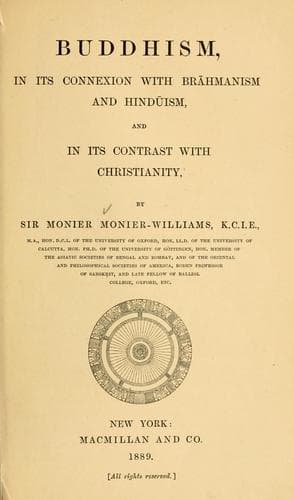
Buddhism, in Its Connexion with Brahmanism and Hinduism, and in Its Contrast with ChristianityMonier-Williams, Monier, Sir
Religion
Buddhism, in Its Connexion with Brahmanism and Hinduism, and in Its Contrast with Christianity
Monier-Williams, Monier, Sir
Buddhism; Buddhism -- Relations -- Christianity; Christianity and other religions -- Buddhism; India -- Religion
Some of the books, clothes, and sacred or secular utensils which the
dead Lāma was in the habit of using, are brought and mixed with others.
The child is then asked to pick out the true ones, or he has to answer
questions as to the events in his previous state of existence. If the
replies are satisfactory, he is installed as the re-born Lāma amid great
rejoicings.
Koeppen asserts that no positive information as to the relationship
between the Dalai and Panchen Lāmas is forthcoming. Some maintain that
both hierarchical systems developed simultaneously. Some say that the
Panchen Lāma of Tashi Lunpo was the first Grand Avatāra Lama, while
others hold that the elevation of the Panchen Lāmas took place later,
and only resulted from the increase in importance of the Tashi Lunpo
monastery in which they reside (p. 284).
The Dalai Lāmas may be enumerated as follow:—
The first is said to have been Gedun grub pa (otherwise pronounced Gedun
dubpa). Probably he was the nephew and chief pupil of the Reformer Tsong
Khapa. It was he who founded the monastery of Tashi Lunpo in 1445, and
he is by some therefore called the first Lāma of that monastery. His
birth is supposed to have occurred in 1391 or 1419, and his death in
1473 or 1476. Then he was born again after ten months as Gedun GyamThso
(or Gedun Yamtso), the second Grand Lāma, who is held by some to have
been the real founder of the Avatāra system of perpetual succession by
reincarnations. He filled the Dalai Lāma Chair from 1474 or 1476 to 1540
or 1542.
The third embodiment took place in 1543, and bore the name Sod nam
GyamThso (or Sod nam Yamtso), ‘sea of virtue.’ He was the first who
really took the half Mongolian title of Dalai Lāma. Moreover, he
laboured hard to spread Buddhism among the Mongolians, and founded the
first Great Lāma’s Chair in Mongolia.
In his fourth re-birth, the Dalai Lāma took the name of Yon Jan Yam
Thso, ‘ocean of merit,’ and lived up to his 14th year (until 1602) in
Mongolia, when he moved to Lhāssa.
The fifth Dalai Lāma was the great Navang Lobsang (strictly Ngag dBang
bLo bSang), ‘wise speaker or eloquent sage,’ who is the most celebrated
of all. According to some he was the first real Dalai Lāma, those who
preceded him being merely supreme Lāmas of the Yellow school. His career
lasted from 1617 to 1682. He was a kind of Lāmistic Innocent. But his
long minority led to political disturbances. In the end, Navang Lobsang
overcame all difficulties, and as a sign that the power of a king of
Tibet had been made over to him, built on one summit of the triple hill
Potala, where once the royal castle had stood, that palatial
monastery—that wonderful Lāmistic Vatican—in which he still resides in
his continual re-incarnations (see p. 330).
Public-domain text, read in full here on John Shaqi.
Reviews
Reviews
No reviews yet
Be the first to share your thoughts on this work.
Elsewhere in the archive
Join the Discussion
Join the discussion
Sign in to leave a comment or review.
Sign InorCreate an account