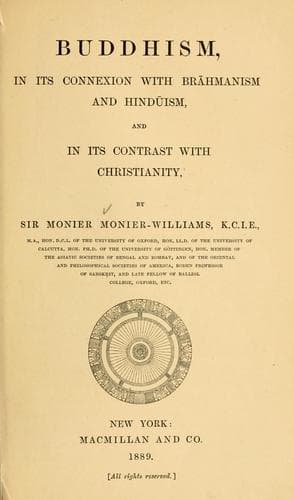
Buddhism, in Its Connexion with Brahmanism and Hinduism, and in Its Contrast with ChristianityMonier-Williams, Monier, Sir
Religion
Buddhism, in Its Connexion with Brahmanism and Hinduism, and in Its Contrast with Christianity
Monier-Williams, Monier, Sir
Buddhism; Buddhism -- Relations -- Christianity; Christianity and other religions -- Buddhism; India -- Religion
Doubtless Japan once had a peculiar hierarchical organization of its
own, which crumbled away not long ago, and need not now be described.
Even in the present day each sect may have its leader or Head, who
exercises a kind of episcopal superintendence like that of a Bishop or
Archbishop.
We have already mentioned (p. 200) that a female form of Avalokiteṡvara
is worshipped in Japan and China as the goddess of mercy. Her name in
China is Kwan-yin, and in Japan Kwan-non; and she is represented as
possessing any number of eyes and arms up to a thousand, and sometimes
three faces.
In concluding this Lecture we may note that Russia is the only European
country to which Lāmistic Buddhism has hitherto penetrated. There are
adherents of the Dalai Lāma among the Burat (Buryad) tribes on the
Baikal Lake, and among the Kalmuks on the Volga. Koeppen informs us that
the chief temple and monastery of the former is on a lake thirty versts
to the North-west of Selenginsk, and that the presiding monk is called
the Khanpo Paṇḍita and claims to be an Avatāra Lāma. The Chief Lāma of
the latter is said to be appointed by the Russian Government.
Hierarchical Buddhism naturally leads us on to the subject of ceremonial
Buddhism, which must be reserved for the next Lecture.
LECTURE XII.
_Ceremonial and Ritualistic Buddhism._
Having in the last Lecture described the manner in which hierarchical
systems were established in various Buddhist countries, we are naturally
led on to consider in the present Lecture the development of what may be
called ‘Ceremonial and Ritualistic Buddhism’; for no hierarchy can
maintain its hold over the masses anywhere without the aid of outward
manifestations, rites, ceremonies, and appeals to the senses.
Early Buddhism was, as we have already shown, vehemently opposed, not
only to all sacerdotalism, but to all merely external ritualistic and
ceremonial observances. It swept away the whole Vedic ritual—the whole
sacrificial system of the Brāhmans; it rejected all penitential
austerities and painful bodily mortifications; it denounced every form
of superstition, idolatry, and priestcraft; it maintained that to lead a
life of purity and high morality was better than all the forms and
ceremonies of religion.
But the very vehemence of its opposition tended to bring about a
reaction. Indeed, the history of all religious movements proves that the
teaching of extreme doctrines of any kind is almost invariably followed
by a Nemesis, though the teacher of them may himself not live to see it.
At the outset a reformer of the ultra type is sure to gain adherents by
his enthusiasm and earnestness, as well as by his ardour in condemning
abuses, but a time is almost certain to come when his followers will
themselves lapse into the identical practices which it was his great
object to denounce.
Public-domain text, read in full here on John Shaqi.
Reviews
Reviews
No reviews yet
Be the first to share your thoughts on this work.
Elsewhere in the archive
Join the Discussion
Join the discussion
Sign in to leave a comment or review.
Sign InorCreate an account