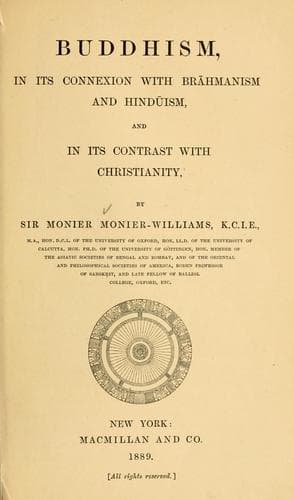
Buddhism, in Its Connexion with Brahmanism and Hinduism, and in Its Contrast with ChristianityMonier-Williams, Monier, Sir
Religion
Buddhism, in Its Connexion with Brahmanism and Hinduism, and in Its Contrast with Christianity
Monier-Williams, Monier, Sir
Buddhism; Buddhism -- Relations -- Christianity; Christianity and other religions -- Buddhism; India -- Religion
At all events, it is well known that in the present day the Buddha’s
followers have invented a mass of complicated forms and ceremonies
wholly out of keeping and incompatible with the purer and simpler system
which he himself sought to establish.
In point of fact the Buddha in promulgating his creed did not take into
account the impossibility of eradicating certain deep-seated cravings
inherent in human nature, which every religion aiming at general
acceptance must reckon with and satisfy:—for example, the craving for
the visible, for the audible, and for the tangible; the craving for some
concrete impersonation of infinite goodness and power; the craving for
freedom from personal responsibility and for its transference to a
priesthood; the craving for deliverance from the pains and penalties of
sin; the craving for an infallible guide in all matters of faith and
doctrine.
Later Buddhism, on the other hand, set itself to satisfy these
longings—these ineradicable yearnings of the human heart. It felt that
it could not establish itself on a firm foundation without hierarchical
organizations, and it could not maintain these without external forms,
ceremonies, and ritual observances. It therefore turned the simple
monastic brotherhood into a caste of priests, and it attracted and
gratified the senses of unthinking multitudes by a great variety of
religious rites, usages, and symbols, many of which are quite unique,
while nearly all are accompanied with superstitious practices implying
an amount of ignorance and credulity on the part of the people, quite
unparalleled.
This corrupt phase of Buddhism is especially dominant in Tibet,
Mongolia, and Northern countries. In real truth it might be affirmed of
every Buddhist in Tibet that religious superstition colours all his
thoughts, words, and deeds. It is interwoven with the tissue of his
daily life, and is part and parcel of his worldly occupations. It is
equally part and parcel of the national life, and enters into every
Government transaction. Furthermore, it is fostered by art and science,
and ministered to by painting and sculpture. Nay, it is stamped on
Nature itself. It is impressed on rocks, stones, and trees. It finds its
way to the summit of snow-clad mountains, to the recesses of
inaccessible ravines, and to the extremities of remote deserts.
To crown all, it might be affirmed that in Tibet religious superstition
goes on by machinery, quite independently of the human will. It is kept
in continual activity, night and day, by the flapping of flags, and by
the revolution of innumerable wheels and cylinders, which are acted on
by the forces of wind and water.
Public-domain text, read in full here on John Shaqi.
Reviews
Reviews
No reviews yet
Be the first to share your thoughts on this work.
Elsewhere in the archive
Join the Discussion
Join the discussion
Sign in to leave a comment or review.
Sign InorCreate an account