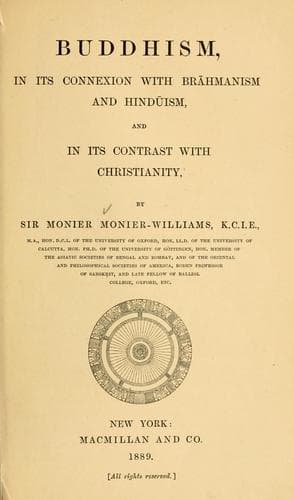
Buddhism, in Its Connexion with Brahmanism and Hinduism, and in Its Contrast with ChristianityMonier-Williams, Monier, Sir
Religion
Buddhism, in Its Connexion with Brahmanism and Hinduism, and in Its Contrast with Christianity
Monier-Williams, Monier, Sir
Buddhism; Buddhism -- Relations -- Christianity; Christianity and other religions -- Buddhism; India -- Religion
The present admission-ceremony in Ceylon appears to be of a simpler
character. In fact it differs little from the ancient form. Those boys
who are destined for the novitiate usually begin their connexion with
the monastery to which they intend to belong by first becoming pupils in
the monastery-school. The devotion of the monkhood to the education of
mere boys was perhaps one of the best results of the progress and
development of Buddhism. In monasteries, all boys may learn to read and
write[138]. There also they gain some experience of monastic duties and
requirements, so that when the time comes for any pupil to enter the
novitiate, his preparedness is taken for granted. He merely makes known
his intention to a superior or senior monk. Then having shaved his head,
and undergone the ceremony of bathing, the applicant, who has furnished
himself with the proper yellow robes, presents them to the superior
monk, and requests to be allowed to receive them again that he may
become a novice. Next, on his reciting the three-refuge formulary, and
the ten prohibitions, he is permitted to take back the monkish garments
and to put them on. He is then formally admitted, and his admission
announced to the other members of the monastery (Hardy’s Eastern
Monachism, p. 23). It may be noted that the monkish garments do not
include a head-covering as in Northern countries.
As to the ceremony of admission to the full monkhood, it differs so
little from the ancient rite (described at p. 79), that no further
description need here be given.
With regard to the religious services performed in the monastic
institutions of modern times, they are, of course, a great advance on
the simple formularies used in early days, before the establishment and
organization of large monasteries.
The earlier and purer Buddhism, as we have seen, had only one religious
formula, and that was a simple expression of veneration for the three
jewels—the Buddha, his Law, and his Order of Monks (p. 78).
Any form of worship was altogether out of place, if not a mere mockery,
when there was no supreme Being to worship; when the Buddha himself, who
never claimed to be more than a perfected man, had passed away into
non-existence, and when all that he left behind was the great ideal of
his own memory, to be venerated and imitated.
When, however, monastic establishments were organized and the doctrine
became developed, a great development of worship took place.
To illustrate this I submit a description of daily life in a Burmese
monastery, based on the information given by Shway Yoe (p. 307), and
often using his words.
Public-domain text, read in full here on John Shaqi.
Reviews
Reviews
No reviews yet
Be the first to share your thoughts on this work.
Elsewhere in the archive
Join the Discussion
Join the discussion
Sign in to leave a comment or review.
Sign InorCreate an account