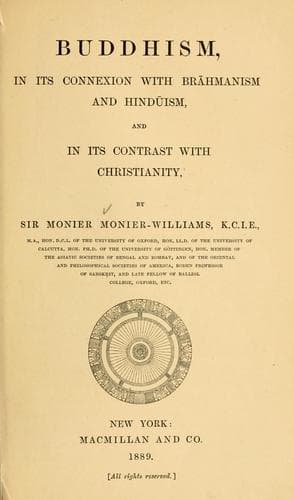
Buddhism, in Its Connexion with Brahmanism and Hinduism, and in Its Contrast with ChristianityMonier-Williams, Monier, Sir
Religion
Buddhism, in Its Connexion with Brahmanism and Hinduism, and in Its Contrast with Christianity
Monier-Williams, Monier, Sir
Buddhism; Buddhism -- Relations -- Christianity; Christianity and other religions -- Buddhism; India -- Religion
The recitation of the Pirit continues uninterruptedly, day and night,
for seven days. Twenty-four priests are employed, two of whom are
constantly seated on the platform and engaged in reciting. Moreover
three times in each day—at sunrise, mid-day, and sunset—they all
assemble together and chant in chorus. Of course, when the recitation of
the Suttas constituting the Pirit is concluded, it is recommenced, and
in this way all the Suttas are recited again and again. On the morning
of the seventh day a messenger is sent to a neighbouring temple to
invite the attendance of the gods. Then by a stretch of the imagination
certain of the gods and spirits are believed to answer the summons, and
on their supposed arrival, the protective Suttas are chanted more
energetically than ever till the morning of the eighth day, when a
benediction concludes the ceremony, and offerings of robes are made to
the priest-reciters.
We now pass on to Tibet and Mongolia.
The ceremonies of admission to the monkhood in those countries do not
deviate sufficiently from the practices just described to require
special notice.
With regard, however, to the dress of Lāmistic monks after their
admission to the Order, the ancient rule, as we have seen, obliged them
to wear only three garments of a dirty yellowish colour, made out of
rags, or picked up in cemeteries or on dust heaps. But the necessities
of a colder climate have compelled the Lāmas to increase their official
vestments, and the higher Lāmas sometimes wear bright silken robes
enriched with ornament. The law is sufficiently obeyed by putting a
patch or two at one corner.
A full equipment is supposed to consist of an under vestment, a sort of
tunic worn over it, a mantle, a kind of scarf worn over the left
shoulder, a loose robe brought round over the same shoulder, and a
cap[142]. The right shoulder is rarely bare, as it generally is in
Southern Buddhist countries.
The colour of these six articles of clothing, especially of the cap, is
yellow or red, according to the sect to which a monk belongs.
The cap is an important mark of sectarian difference, and is of various
forms, and when it has five points, has been compared to a bishop’s
mitre, but the five points really denote the five Dhyāni-Buddhas and
their Bodhi-sattvas.
Public-domain text, read in full here on John Shaqi.
Reviews
Reviews
No reviews yet
Be the first to share your thoughts on this work.
Elsewhere in the archive
Join the Discussion
Join the discussion
Sign in to leave a comment or review.
Sign InorCreate an account