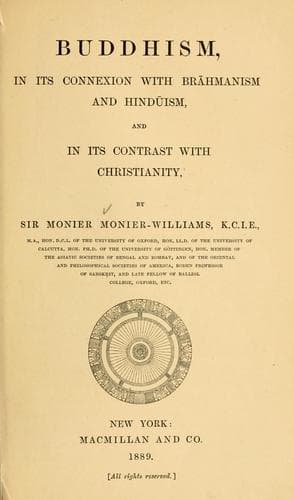
Buddhism, in Its Connexion with Brahmanism and Hinduism, and in Its Contrast with ChristianityMonier-Williams, Monier, Sir
Religion
Buddhism, in Its Connexion with Brahmanism and Hinduism, and in Its Contrast with Christianity
Monier-Williams, Monier, Sir
Buddhism; Buddhism -- Relations -- Christianity; Christianity and other religions -- Buddhism; India -- Religion
‘Their old karma is destroyed, no new karma is produced. Their hearts
no longer cleaving to future life, their seed of existence destroyed,
their desires quenched, the righteous are extinguished like this lamp.
The priesthood is this glorious jewel. May this truth bring
prosperity! Ye spirits here assembled—those of earth and those of
air—let us bow before Buddha—let us bow before the Law—let us bow
before the Monkhood.’
Part of the third or Karaṇīya-metta-sutta runs as follows:—
This is what should be done by him who is wise in seeking his own
good. Contented and cheerful, not oppressed with the cares of this
world, not burdened with riches, tranquil, discreet, not arrogant, not
greedy for gifts, let him not do any mean action for which others who
are wise might reprove him. Let all creatures be happy and prosperous;
let them be of joyful mind. Let no man in any place deceive another,
nor let him be harsh towards any one; let him not, out of anger or
resentment, wish ill to his neighbour. As a mother, so long as she
lives, watches over her child, her only child, so among all beings let
boundless goodwill prevail. Let goodwill without measure, impartial,
unmixed with enmity, prevail throughout the world, above, below,
around.
The Rev. D. J. Gogerley witnessed the performance of a great Pirit
ceremony in Ceylon (Hardy’s Monachism, p. 240). Taking his account and
that of Mr. Dickson, I have compiled the following brief description of
the Mahā-baṇa Pirit, ‘great Pirit recitation’:—
So soon as the sun has set crowds of people arrive at the
Recitation-Hall, bringing oil-lamps made out of cocoanut-shells. The
Hall is decorated, and a canopy, shaped like a pagoda, is erected over
the pulpits, which are placed on a raised platform. When darkness
supervenes a blaze of light illuminates the Hall. A relic of the Buddha
is deposited on the platform, and a sacred thread is fastened round the
Hall, one extremity of it being brought close to the relic and to the
Reciters. On the morning of the next day, the recitations begin. One of
the Reciters repeats the three-refuge formula, and the five commandments
(see pp. 78, 126). Then incense is burnt round the platform, and the
musicians outside the Hall strike up a lively air. Next, the formula of
‘the twelve successive causes of existence’ (see p. 102) is intoned, and
a hymn of victory chanted.
Public-domain text, read in full here on John Shaqi.
Reviews
Reviews
No reviews yet
Be the first to share your thoughts on this work.
Elsewhere in the archive
Join the Discussion
Join the discussion
Sign in to leave a comment or review.
Sign InorCreate an account