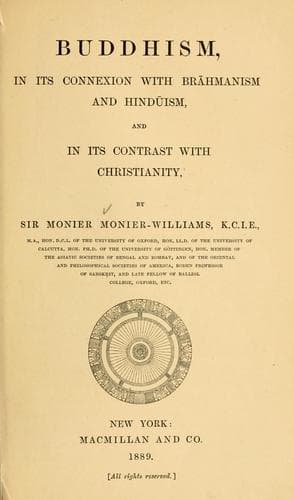
Buddhism, in Its Connexion with Brahmanism and Hinduism, and in Its Contrast with ChristianityMonier-Williams, Monier, Sir
Religion
Buddhism, in Its Connexion with Brahmanism and Hinduism, and in Its Contrast with Christianity
Monier-Williams, Monier, Sir
Buddhism; Buddhism -- Relations -- Christianity; Christianity and other religions -- Buddhism; India -- Religion
Finally, he prostrated himself three times before the Grand Lāma’s
throne. A solemn pause followed; after which the audience rose, and the
Grand Lāma retired. Mr. Sarat Chandra Dās goes on to relate that at the
end of the ceremony one of the assistant Lāmas gave him two packets of
pills, and another tied a scrap of red silk round his neck. The pills,
he was told, were chinlab or blessings, consecrated by the Buddha and
other saints; and the consecrated scrap of silk, called sungdū, ‘knot of
blessing,’ was the Grand Lāma’s usual return for presents made to him by
pilgrims and devotees.
We may note here that in 1866 the Indian explorer Nain Singh saw the
then Dalai Lāma. He was a handsome boy about thirteen years old, and was
seated on a throne six feet high. He had the Regent on his right hand.
He was said to be in his thirteenth transmigration[154].
Dr. Schlagintweit (p. 239) describes a ceremony in which consecrated
water (thui) is poured from a teapot-like vessel over a metallic mirror
(pp. 458, 463 of these Lectures), which is held so as to reflect the
image of Gautama Buddha seated on the altar. This water falls down into
a flat vessel containing a bag filled with rice, and is then suitable
for ceremonial ablutions.
Another ceremony (called Nyungne? by Schlagintweit), involving long
abstinence, lasts for four days.
The first and second days are passed in preparations. Those who are to
take part in the ceremony rise at sunrise, bathe and prostrate
themselves several times before the image of Avalokiteṡvara. The head
Lāma then bids them confess their faults, and meditate on the evils
resulting from demerit. He next, with his attendants, recites extracts
from certain books of confession. This goes on till ten o’clock, when
tea is taken. After this the recitations and prayer-recitals continue
till two o’clock, when a meal of vegetables is eaten. Then comes a
pause, but the prayers and readings are afterwards carried on till late
at night, tea being handed round at intervals. Before retiring to rest,
the head Lāma specifies the various duties to be performed by the
devotees on the following day, and orders them, as a penance, to sleep
in ‘the lion-posture,’ viz. to lie on the right side, to stretch out the
feet and to support the head with the right hand[155].
The third day is the most important, and is passed in rigorous
abstinence from all food. No one is even allowed to swallow his saliva,
which must be ejected into a vessel placed before him. Not a word must
be spoken. Each man prays and confesses his sins, but does so in
absolute silence. This continues till sunrise on the fourth day.
It was at first the rule that repetitions of the Law, confessions of sin
(especially the Pātimokkha), and some of the chief religious ceremonies
(including fasting) should take place, more particularly on the days of
new and full moon (called Uposatha, p. 84).
Public-domain text, read in full here on John Shaqi.
Reviews
Reviews
No reviews yet
Be the first to share your thoughts on this work.
Elsewhere in the archive
Join the Discussion
Join the discussion
Sign in to leave a comment or review.
Sign InorCreate an account